Thursday, 9 May 2013

Cooking is scary


It is. It's pooh scary. It's partly why I do it. Every single occasion is risky. From the mundane burning of toast to the exotic chemistry of split emulsions and gluten reactions to the nobody-knows of the unrisen macaron.

Almost anything can go wrong. Old, reliable, established recipes can suddenly result in something shockingly dull or dry. Often, the reason is arrived at with a slap of the forehead and an unused ingredient lurking behind a pot. But sometimes... God knows. I have made salmon paté many times. Never goes wrong. I tried the recipe with smoked mackerel (spelt with two 'e's. Who knew?). The result was inedible. It split to buggery and back, acquiring the texture of wet sand. Nothing would retrieve it. NOTHING. Still don't know why. If you have a idea, please do let me know.

Sugar and eggs are often culprits. The egg is particularly devious; containing two discreet units of yolky fat and albumen protein. You can whisk miracles with these, everything from Italian Meringue to mayonnaise, fried-over-easy to perfectly poached. But beware once heat and/or further fat is applied. Custards will move from runny to scrambled in a spoon beat. Mayos will run apart like squabbling siblings. Fine sieves and fast blenders are your friends here.

Worse is sucrose. Sugar's nature changes every few degrees over 110°C. 112°C gives you fudge, 120°C marshmallows and gummy bears, 148°C results in hard toffee and peanut brittle. 175°C and you have a dark, dangerous caramel. 190°C and you have men with yellow hats and hoses. But of course, sugar doesn't change uniformly in temperature, however thick your pan is. If you've made caramel you'll have seen a pale straw suddenly darken and taste of bitter hell.

Temperature is always a concern. Recipes say to 'put it in the oven'. But where? Middle, top, bottom? Pizzas benefit from bottom only heat don't they? I can put two trays of identical profiteroles in my oven, one only two inches below the other, and the bottom rack will take a good 20% longer. This even happens with the fan oven. I will never understand Yorkshire puddings. If the outside ones were burnt that would make sense but occasionally I'll have two seemingly random, much darker than all the others, while one will not rise at all. Of course, is your oven actually at 220? Oven thermometers are the solution there. My oven varies by 15°C top to bottom. I once GRILLED ten lamb shanks for ten minutes because I clicked the mode once too much. Luckily they were wrapped in foil and something charred, alerting me.

Tip: trust your nose: if it smells wrong, it is. If it smells cooked, despite what the recipe calls for, then check. Cooked food smells cooked.

Then there's the range of ingredients that increases daily and the literally limitless combinations thereafter. The world gets smaller. Ten years ago I'd never heard of ras-el-hanout,dragon fruit, Moghrabieh, sumac, or rose harissa. I'll let you Google them.

More locally, the rise of foraging and generally a greater interest in domestic produce has brought samphire, fennel pollen, lesser celandine, ground ivy, liquorice root and sea buckthorn. Do you pan fry them (always on Masterchef!), grill them, blanch them or bake them? For each technique there are parameters to observe. What's too soft or too crunchy? Would you know if your buckfast was ripe? Is ground ivy meant to be stringy?*

Forget the exotic. I'm embarrassed at the range of foods I've never cooked. Albatross, aardvark, panda. OK, but really... lobster, never even looked at one. I've eaten it (invariably I prefer crab - really don't get the lobster hoo-ha) but I've never killed one. But more mundane: grouse, sardines, cauliflower FFS! Shocking.

But nothing is more scary than staring at a pan that contains something eagerly awaited by eight people, all sitting in your dining room, all of whom have paid for the pleasure and only you know that you've made a right arse of it. And you have no more left. And even if you did, it would take four hours to make a new one.

Now this hasn't happened to me... not yet. But it's bound to. Mistakes always happen. I've cooked maybe a dozen dishes, EVER, that I thought could not be improved. Luckily most mistake are small. People won't miss the lack of tarragon garnish or that extra apple crisp but they will miss the main course... because I dropped it, or forgot to put it in the oven, or left it in too long (TIMERS - ALWAYS USE A TIMER. Even if, no especially if, it's only for a couple of minutes). I dread the phrase 'so who likes omelet?' But I know it will come.

One of the real problems with slow cooked meat - if you've been paying attention here you'll know this is my choice - is you don't know if it's tasty, if it's tender, if it's frickin' edible, until the last minute. You can't test fry a piece of pork belly or beef shin or brisket. It could be the best thing you've ever put in your mouth... or the furthest you've ever thrown a piece of cow in frustration.

So far the worst has been me making six apple cakes for seven people. Luckily, graciously, two guests pretended to be full anyway and happy with half each. A sticky toffee sauce split on me once. A fast re-whisk with some extra creams solved that. Forearms like Popeye, me. I've dropped a soufflé but the ramekin didn't break. No one commented that one was a little flatter than the others. I did own up though. I think honesty is better. And when I do suffer a catastrophe I pledge to tell you.


*No.

Sunday, 5 May 2013

Grand Garden Plans

I'm increasingly disheartened at the lack of herb choice in supermarkets - it's always the same eight. But, providentially, this culmination of dismay coincided with the removal of my sons' trampoline from the back garden so I now have a sunny, sheltered space just crying out for raised beds.

I'm starting small, with two little seedling propagation units, oh, and two lemon verbena plants that were ordered in error; I thought they were seeds.

Lemon verbena. Wants to be in a vinaigrette or cut up
with crab meat.
Garlic chives, borage, chervil and the lemon verbena are my choice. Chervil is one of those herbs that are always called for in recipies, especially classic French stuff, but is almost impossible to buy fresh. 

I'm not sure I could identify the chervil flavour in food but I read that it's a mild aniseed so I'm expecting Dill-lite. 

I want borage mainly for its gorgeous (if slightly terrifying were they scaled up to the size of a man) edible flowers. The herb itself tastes of cucumber which is a bad thing, cucumber being an offence to god(s) and nature. Of course, you may like the green rod of slime and will carp on about the delights of Raita or Tzatziki, in which case I will reply that the yogurt and mint obliterates the taste anyway, and rightly so. You might say you enjoy crisp, succulent cucumber in your tuna sandwich. I would reply that if I wanted someone to sneeze on my lunch I'd do it myself. I'm saying, in case you missed it, that I don't like cucumber.

Next I have to actually build the raised beds. Why not just plant? Because the soil in our garden is awful London Clay. There's also a whopping great Sycamore so the soil is very dry in summer and a squelchy mess in winter. Greater minds than mine have sucked their teeth (yes, minds have teeth) and told me I would need much soil improver, sharp sand and a soak-away drainage system. And this would all be very expensive. I'm always amazed at how costly it is moving dirt.

So I'm going to buy some tanalised timbers and a tonne of topsoil and make my own rather than buying a kit. This shouldn't cost more than a £150 I'm hoping. It does mean a lot of soil to wheelbarrow but I currently have an adolescent standing idle who will still just about obey my bidding.

I want to expand the beds beyond herbs obviously, growing bizarre veg, tomatoes that actually taste of something and most importantly... strawberries. I have this idea of guests tramping up the garden (in their stilettos, yes) and picking their own dessert.
Will soon be the site of my raised beds. Do you like my star gate BTW? It's turned off at the moment because it was very inconvenient walking into the shed to get the secateurs only to end up a hundred billion light years away. 
I never knew what to pack for a start. 


Friday, 3 May 2013

New spring starter - gnocchi, bacon and broad beans

I've been waiting for the end of winter. Waiting. And waiting. Now a climate less frigid has arrived in Palmers Green, I've flung open the patio doors and embraced the new season veg. Only one problem... you'll see. Read on.

I'm currently in love with herby French Gnocchi. I've tried a few recipes (mainly Thomas Kellner) but wanted to produce one of my own. This is it: Gnocchi with bacon and broad beans in a creme fraiche dressing.


You need two types of bacon: streaky and lardons. Both should be smoked. Unsmoked bacon is an offence to man, God and nature. It's like licking a damp pig. Avoid.

The lardons should be cooked slowly to render out much of the fat. The streaky should be cooked flat under a weight - a flat lid perhaps. You want soft lardons and crispy streaky.

Set your bacon(s) aside. 

Meanwhile, fry up your gnocchi in much brown butter. Keep an eye on the heat though, you don't want black butter: it's disgusting. Don't overcrowd your frying pain either - as I have here. Better to do batches and keep them toasty and crisp in the oven.

Make up the dressing:
3 big tablespoons creme fraiche with half a tablespoon of red wine vinegar infused with garlic (leave them jam-jarred in the fridge for a few days), 2 teaspoons of dijon mustard, a scant half teaspoon of English mustard, two big pinches of freshly grated parmesan (you'd never be tempted to use the shop bought dried stuff would you?!)
a squeeze of lemon juice - to taste, pinch of smoked paprika and a pinch of cayenne


So it's a little bit like a caesar salad dressing but without the anchovies. It should be quite an acidic dressing and with a bit of a bite. There's much fattness to cut through here.

Now to the issue of veg. Put simply: unless you are podding peas or beans on your apron, minutes after plucking them from the vine... frozen are better. I'm not alone in this opinion. So blanch your frozen broad beans for two minutes in boiling water, refresh in icy water and then set aside.


To assemble the dish, toss the beans in the bacon fat of the lardons to briefly warm through and then plonk on plates with the gnocchi and lardons. Drizzle the plate with the dressing and some chopped chives (or herb of choice) and garnish with the wafer of streaky bacon and a good clutch of parsley.


Sunday, 28 April 2013

Bill's Big Bash

Parties of ten are always going to be a challenge, just in terms of crockery if nothing else. But also anything on the hob needs careful thought. Do I have a pan big enough?

Bill's party were great fun and very catholic in their tastes; no lamb and no smoked salmon being their only stipulation. I grabbed my chance to cook pork belly again. There's nothing quite like a good soft belly with glass-brittle crackling.

They arrived slightly late (problems on the M25) and with a very high bottle-to-person ratio! Although I was informed this was normal. I must confess that I see this as a good sign (being a little bit of a drinker myself). I think it shows a certain doughty insistence that you are going to enjoy yourself. In the end they took six bottles away with them at midnight... back to another house to continue the party.


Starters was new: herby gnocchi with butternut squash, mushrooms and fried tomatoes in brown butter. To be very honest, it wasn't quite as good as I'd hoped. I'd made it several times in the week and again on the day but then scaling up to ten servings meant the gnocci wasn't as crisp as I'd like. Simply too much moisture in the pan I think. Ah well... next time I'll do them in smaller batches and keep them crisp in the oven; the same way I maintain my potato rösti. Mains was slow roasted pork belly with a Marsala reduction, served with a fennel tarte tatin, roast onion puree, parsnip and apple puree and green beans. That's Bill on the right finishing his pork. 


Dessert was one of my most successful: the sticky apple tarts and rhubarb sorbet. Everyone seems to like this. It is a bit of an adventure though, prepping ten plates with a frozen element. Needs some careful planning. The square plates were a Christmas present from my youngest son Etien, who's now showing some enthusiam to get involved. He's a bit of a cook himself. He specialises in home-made pizza (including the dough).


Wednesday, 24 April 2013

French Gnocchi

I'm always looking for recipes to make into vegetarian staples for the restaurant. Vegetarians seem to be a group of people all too ready to accept a lack of choice when eating out. Now I'm a meat fiend but I think they deserve more than simply pasta and cheese or something tasteless roasted with... usually cheese. I found this in Bouchon: Thomas Kellner's book of bistro meals (him of the French Laundry). These are French dumplings, nothing like their rubbery little Italian name-sakes, made using choux pastry.

This is the end result. They are wonderfully light little crispy pillows and fragrant too.


This one amount will feed about 20 as starter or side order I'd imagine.

Add 170g unsalted butter to 350g water and bring to a simmer. Throw in 270g of plain flour and beat smooth (as you would with a roux). Stir over a medium heat for a few minutes to remove some of the moisture from the dough. You should be able to smell cooked dough. Now add 2 tablespoons of Dijon mustard and a tablespoon of sea salt. Balking at that amount? Don't be tempted to skimp on either, the finished result is neither too salty nor too Dijon-y. Add a handful of herbs of your choice (Dill, parsley and chives were mine) and a handful of flavoursome cheese (Gruyere). With your food mixer, beat in five eggs, one by one until you reach a firm but mobile consistency. You might need a sixth egg (I did). You're looking for something like cream cheese consistency. Put this mix into a piping bag and allow to relax for half an hour.


Now snip a half inch end off the bag (or use a half inch bit - should have mentioned that earlier) and over a big pan of salted, gently boiling water pipe and chop the mix into half inch sections. It's easy to do: squeeze and chop, squeeze and chop. Do batches of about 20. Any more and you risk over cooking the early ones. They look a little grim at this stage (like dismembered fingers - or maybe that's just me).

The dumplings will sink at first. When they float, cook for a further two minutes. Lift and drain on a clean tea towel. These can be refrigerated for 24 hours now or frozen for six weeks (or, let's face it, until you stumble upon them while looking for that frozen bottle of vodka at Christmas).

To serve the gnocchi, heat some butter and a dash of oil until it's foaming and browning (beurre noisette) and ease in the gnocchi. Cook over a medium heat for two to three minutes until crisp and golden on all sides.


This all might sound like a faff, especially when you can cook some pasta in ten minutes, but these are a delight and can be arsed around with indefinitely using different combos of flavourings/herbs/seasonings/cheeses I imagine. I wonder what sweet ones would be like. Oh! Cinnamon with hot apple sauce and Chantilly cream.

Also good with broad beans and lardons in a creamy garlic dressing.

Sunday, 21 April 2013

Two more... ahem... essentials

Always the same, as soon as you hit the return key. How could I forget?

Mandolin
Also spelled with an additional 'e' (I've just discovered). Fascinating etymological history. A kitchen mandolin/e allows you to slice with a pre-determined thickness consistently and evenly. It also chips and juliennes. You can waffle cut with some labyrinthine two cut process that I've never been faffed to work out. Faster than a knife. OK, faster than me with a knife. Essential for slicing fruit for drying and for fine cutting squishy stuff like tomatoes that bulge and burst under a knife. I use it for preparing pomme dauphinoise or boulangere, chips, galettes and especially for fine slicing onions prior to a long roast on the puree path. Much easier to clean than the MagiMix, which let's face it, now it's not listening, is a bit of a pain in the arse.


Peeler
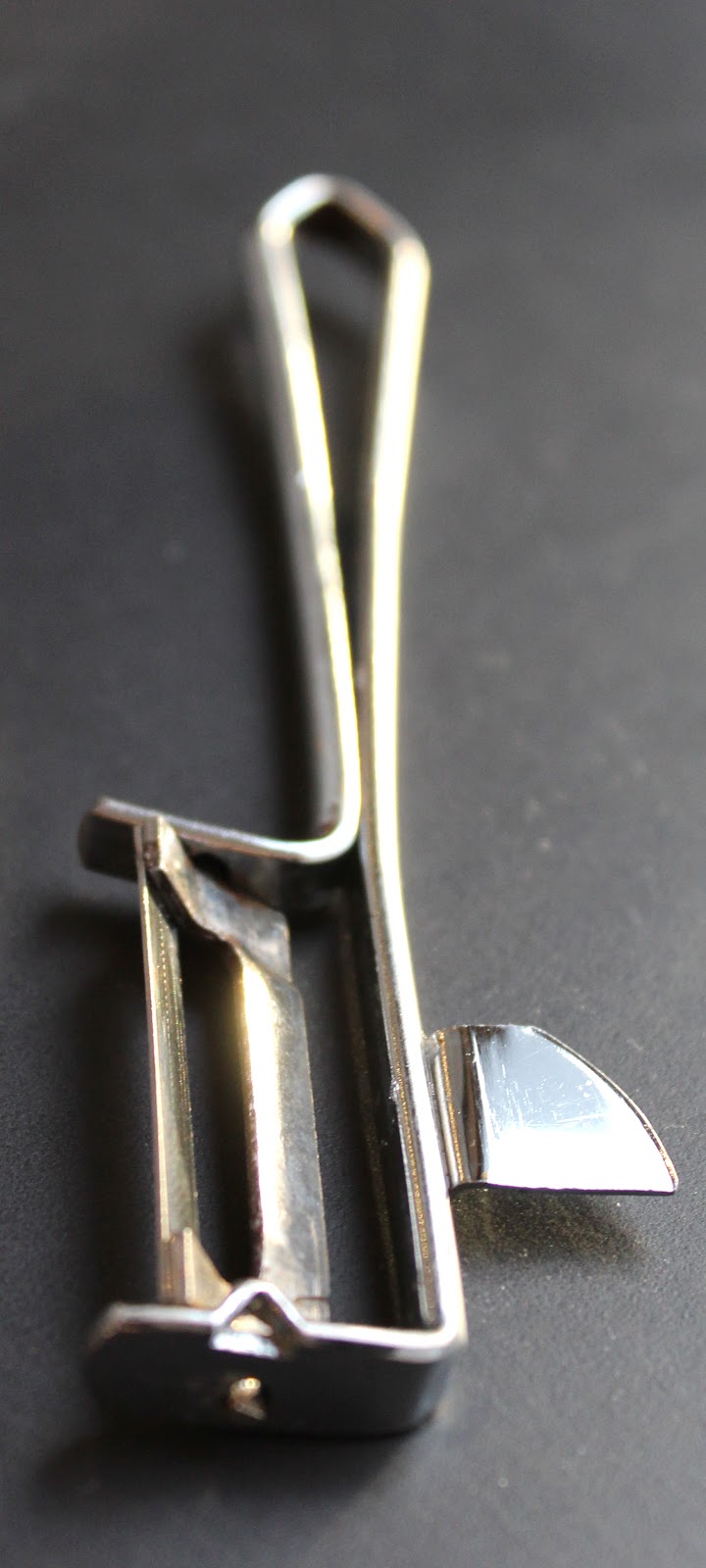
I think this was bought for me by Mark Narraway, my best friend in school. I'd visited him at his girlfriend's house (now his wife) and used her mother's there. Her mother was German and I think the peeler is too. Anyway, it's probably thirty years old. I panic if I think this is lost but it's normally to be found hiding in plain sight in the dishwasher. It peels more thinly than others and has that handy stubby blade for de-blackbit-ing. I can do a potato in well under 20 seconds with this. Rubbish for carrots though.


Seven essentials (and one more... essential)

So that's eight essentials but who's counting? Oh, right, I am.

A list of things I can't do without. Alright I could do without but I'd rather not. The items below represent, in my opinion, the best of their class. Some cost hundreds of pounds, some are under a fiver, doesn't matter... so long as they do their job properly.

These are the actual items I use in my kitchen so they won't be in forecourt condition. They might be a bit worn and stained but it matters nought.

Tongs
These tongs are your boys. It has to be these cheap, pressed metal ones. Forget those with rubbery bits or 'cheerful' plastic obscenities given to you for Christmas that burn if you leave them hanging on the edge of a pan. Easy to clean too. I'm amazed at how many people don't have these in their kitchen.


Magimix Food Processor
Wow. Really!? How tiresome. No surprises here then. Thumb through any and all kitchen magazines and you'll see one of these on most middle-class work surfaces. They are as ubiquitous as the Dualit 4 slot toaster. However, this is no mere style statement.These babies are everywhere because they work well and they are very reliable. Almost stupidly simple to use. There's one off switch, one on and one pulse. I have the model with three nested bowls. I almost never use the middle one though. The small one is great for cheese, nuts or herbs. There's also a grating and a slicing plate which doesn't see much use now I have a mandolin... Argh! A mandolin... which I should also have included in this list. Bugger! OK. That's nine essentials. Shoot me.


Silpat Silicon Mats
You can buy cheaper but not better. The big advantage of Silpat is that it lies flat. Cheaper silicon flaps up and then slaps about excitedly (especially in a fan oven) and makes a mockery of your meringues. Silpat is a brilliant non stick surface. Next time you're in a posh restaurant check the underside of their tuiles and you'll see that tell-tale woven pattern. You might look strange but at least you'll know. 

Without this I couldn't dry fruit. I would be scared of attempting tuiles, meringues and macaroons. I use these two to sandwich my caramel when I make nut brittle. They go into oven and freezer and between the both. They seem to last a long time. These two are five years old.


Sugar Thermometer
Time was when you would take blobs of molten sugar and drop it into water to see what state it had attained. Hence names like hard ball and small crack. Now we use thermometers. These really are essential. You can't make a decent stab at caramel or other sugar work without one. I use mine weekly, if not for caramel, then for honeycomb or Italian meringue. Mine does look battered but so would you if you'd been dunked in hot sugar syrup for twenty years.


Spoonulas
Not spatulas and not spoons, spoonulas are wonderful utensils are made from a heat-proof rubber and plastic and are just the right shape and flex to squidge into most spaces. They leave bowls and pots clean. Being heat proof means I can use them in sugar work. I have about six and I'd like more. They claim to be stain resistant but carrot juice does (whereas beetroot doesn't. Don't know why). You can get them here.


Piping Bags
They come in rolls of 500. You tear one off as you need them. They have a slightly textured, grippy outside. If you look in my fridge in the hours before a serving you'll find several of these, the wide end tied or pegged off, full of cream or cake mix, batters, purées, veloutés and what-have-you. Then I just snip the end off and pipe. Great for portion control. Great for not spooning batter or cake mix all over the place. You can cut them down for detailed piping. You know they're sterile and won't contain soap residue to taint your crème chantilly. Yes they aren't very enviro-cool but they are recyclable.


Kitchen Aid Food Mixer
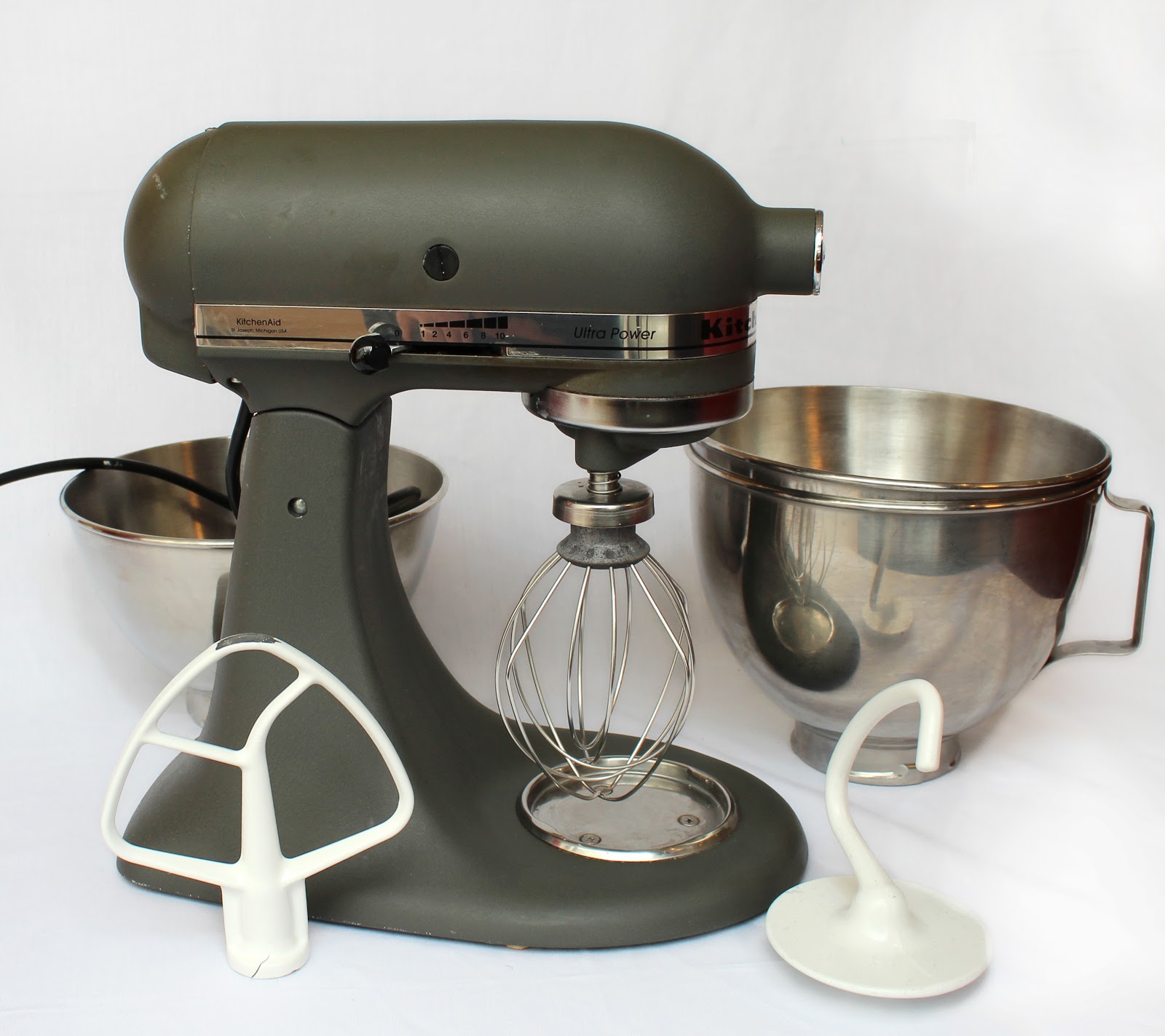
Losing this would be like losing a limb. I can't remember how I used to cook before I had one. All that standing around with a hand whisk or a huge heavy bowl and a damp tea cloth! As my youngest son says far too often: ain't nobody got time for that. The Kitchen Aid means you can leave the dough being thumped about in the bowl and focus on something else. keep an eye out though as it will butter your double cream in a flash.

I use this machine every day. They are famously robust with an engine you could power a barge with. You can see that the beater's actually worn through now (and that's my second beater!). I use it mainly to make bread, cakes, creams, soufflés and meringue. I have the original bowl and two extra. I also have the juicer attachment for the front. This is the ONLY juicer that makes a good job of limes.

I wish they would produce a copper lined bowl, like the old fashioned sabayon coppers; the metal catalyses the eggwhite to create more volume. Here's the science.

Some come with nasty plastic splash guards but these don't work. I think everyone just sticks a tea towel over the whole job don't they?

Now my friend Jeremy works on Wired Magazine and they've just done a test of stand mixers. Shock/Horror! They reckon this is the best. But then, it is £575! It does look rather gorge though. Anyway, I feel sullied now. Kitchen Aids are in the £350 area.

Of course, looking up things on the internet means I've just found this water jacket. Wow. That would be useful for custards and the like. £40 for a metal bowl though. That's one issue with KitchenAid: nothing comes cheap.


7 Leguas Tequila Blanco
Yes, what a wag I am. Of course it's not a kitchen implement but... I do like a sip of this at the end of a serving. I was a fan of Patron Silver (still am - Christmas is coming) until Dick Bradsell introduced me to this (in his bar, sadly he's not a personal friend). Arguably, this is the finest tequila in the world that you can buy without remortgaging. I know most of you think you don't like tequila but that's because you used to slam that disinfectant flavoured toilet water that costs about a tenner. This doesn't cost a tenner and you don't slam it. Save up!

The cheapest place to buy it is here, but you won't buy will you? If you find anywhere cheaper I will happily have your babies if you let me know.


Saturday, 20 April 2013

Anna's birthday crew

Anna's Birthday; her 25th by the look of it.

Anna came as a very late booking, a result of a friend's recommendation (thanks Nish). They'd been looking for a restaurant to house the celebrations and hadn't found much locally. I think this is when the home restaurant comes into its own: a relaxed private space with a pre-arranged menu, your own drinks and a personalised soundtrack (in this case Garage, Old Skool and Hip Hop) you can talk as much as you like about whatever you like. There was eating and drinking and laughing and even a little dancing.

Starters were curd cheese soufflés; one of my reliable vegetarian standbys. Mains was braised beef shin and veg served with a roast onion soft polenta, roast shallot purée and chargrilled courgettes. Dessert was my increasingly popular sticky apple sponges and rhubarb sorbet.

Friday, 19 April 2013

Treacle Soda Bread

Yes, I did just take a bite before I took a photo. And what a difference my new camera makes!

I've started serving this bread instead of my usual griddled focaccia. What I love about soda bread is the 'want bread-make bread-bake bread-eat bread' cycle is only 45 minutes. With focaccia (and most other yeast based) it's at least three hours. And boy this is good, especially with cold, unsalted Lescure butter (as above) just yielding to the warmth of the hot crumb. This is proper delicious: rich, malty, toasty, crunchy

In a bowl add: 250g malted flour, 250g plain flour, teaspoon salt, teaspoon bicarbonate of soda. You can use just white flour, but please don't.

To the dry ingredients add 420ml buttermilk, mixed with a good tablespoon of black treacle. Apparently you can use sour cream instead of the buttermilk. I've not tried it. Buttermilk is available in every large supermarket I've ever been to.

Bring together gently. Don't knead. Shape the dough into a squat round and cut a cross into the top. I sprinkle some rye flour all over but any flour will do. Bake immediately for 30 min at 200°C.

The treacle doesn't make it too sweet, instead it adds some complexity and depth of flavour. You wouldn't know it was there (until you leave it out).


Sunday, 14 April 2013

The trouble with Masterchef

People ask me if I fancy going on Masterchef. Well, no, I don't. It's a question of priorities. Masterchef is at the mercy of production budgets which means that the early rounds (far too many contestants) ask what can you cook in just over an hour. It's all about time and not about food or developing flavours. It means almost everything is pan fried. Nothing wrong with pan frying but it's a technique that favours expensive ingredients; and so you see them: scallops, monk fish, fillets of bass and beef, duck breasts (and some obsession with fondant potatoes, usually pronounced Fon-Dont with great zeal). OK, you can fry eggs and spam but these are rarely seen.

But really: there's no time to roast a cheap joint well or slowly stew something until it's unctuous. Four hours for a melting pork belly? Forget it. What of curries, casseroles, pies, stews, bakes, gratins, steamed puddings, roast joints? In short, all the things I love cooking are impossible on Masterchef. If you want to spanner their works, ask them to make a bread roll!

This a symptom of TV's obsession with cooking food quickly. What's next Jamie? 30 Second Meals? Where you stand in the kitchen with your mouth open and someone pours in the ingredients? We have time. Really. We do. Cook properly, eat well (around a table with your family) and just watch less telly.

It also means that contestants must be using commercial stock and pastry. You can't make decent stock in less than three hours. Hell, I take days. You need a half day to make puff pastry that's worth its name. Even pasta dough benefits from an hour in the fridge. But stock is at the heart of a good soup, sauce or gravy. Watery, cloudy, shop-bought stock is prohibitively expensive too. How can you judge a cook when some of the fundamental ingredients are provided for them? It's not so much cooking as food assembly.

And why is the commercial kitchen thrown in so soon? What does that prove? Again, they aren't really cooking anything; it's all about expensive food arranged on a plate. It's not their recipe. It's an alien kitchen. There's nothing to test their palate.

One more thing. Why the hell doesn't someone open that damn door for the contestants? Get a napkin and wedge it underneath! Why make them take two trips to serve the celebrity judges? A hostesses trolley at the very least. I'd stand there and yell at John and Greg. Has anyone dropped a plate? What would happen then? Today, Greg, I'm serving sea bass with a ginger sauce and ceramic shards.

One more, more thing. Chocolate fondant (Fon-Dont) puddings aren't that difficult any more. Everyone has a foolproof recipe now. Enough. Make bread and butter pudding instead. Oh, sorry, you can't; you're out of time.

Home cooked ham hock. Butt ugly and very slow.

Neil and Catherine's Late Night

A wonderful, long, relaxed evening. This was Neil and Catherine's second time with us and as before, it was great fun. Hope to see you all again soon.

Neil, Catherine and friends. That's the beef they're eating.

I served:
Soda treacle bread and butter. Warm spiced nuts.
Mushroom and truffle velouté.
Ham hock with celeriac remoulade and pea shoots.
Braised shin of beef and vegetables, spinach, Portobello mushrooms, roast onion purée and three mustard mash.
Iced tea ice.
Toffee Blueberries (recipe coming soon).
Sticky apple sponge, rhubarb sorbet, apple crisps, crystallised pistachios.
Orange rum truffles.

My new starter. Home cooked ham hock with celeriac remoulade with chargrilled toast and capers.
The pea shoots are dressed with a honey and mustard glaze.
Portobello mushrooms need only simple grilling to be delicious. I use them to top the beef.

A proper picture of the dessert. I'm now using a Canon 600D. 
The end of the evening.


Monday, 8 April 2013

Rhubarb Sorbet and Sticky Apple Sponges and Crystallised Pistachios (and I need a new camera)

I've been taking pics of the various elements in my new dessert: rhubarb sorbet with a sticky apple sponge, apple crisps and crystallised pistachios. However, even after a good deal of Photoshopping I can't get them to look good. These photos were taken with a Canon Ixy 1000 which is a decent point and shoot but it doesn't deal with low light well. Shadows make food look sinister but a nasty flash makes it look like road kill. I might have to buy a decent camera. I'm thinking of a Canon 600D but if anyone knows different please comment me.

Anyway, for what it's worth, here's the finished dessert. I swear it looked prettier on the night.


This was inspired by a recipe in James Mackenzie's book On the Menu.

I've made rhubarb sorbet many times before. It's a good way to use up that uniquely British product: forced rhubarb. Grown in the dark so it doesn't produce chlorophyll, this rhubarb is an almost embarrassingly, sometimes even metallic, cerise colour. It's one of those foods which looks man-made (I suppose it is though) like star fruit and yellow peppers.


The Sorbet
I make the sorbet by adding lots of rhubarb with just a splash of water and lots of caster sugar into a big pan, sticking the lid on and steaming the whole lot (low heat - I use a diffuser) until it's gloopy. At this stage you can add more sugar to taste and maybe mess about with ginger or rosewater or orange juice. On this occasion I went neat. I puree the whole lot in a blender and then churn in my ice-cream maker. It does have a slightly unusual texture this way... but in a good, interesting way.


The Apple Crisps
Using a mandolin on a setting that results in thin but whole slices... slice a whole apple. Brush the slices with sugar syrup (I used my home-made vanilla sugar syrup) and stick on some Silpat. Don't use baking paper! The slices will stick like shit to a blanket. Dry these out in an oven at 50°C for around 12 hours - maybe more. A long time yes. Just go to bed. They are startlingly delicious though.

This was taken with a nasty flash. See how they look like recently murdered apple slices?

Sponges
This recipe makes six muffin size sponges.

This was taken in proper daylight. Much nicer but much of my cooking is at night.

Cream 125g caster sugar with 125g of unsalted butter. Mix in two eggs, a big pinch of cinnamon powder and 50ml of apple liqueur (I use this one which isn't readily available but worth an internet buy as it has the most wonderful aroma) or apple juice. Fold in 125g of self-raising flour. Bake in the middle shelf at 180°C for between 23 and 26 minutes. Why not just say 25 mins? This sounds pedantic but you'll need to experiment (what a hardship) with your oven to get the sponges just baked. The softer, the better. If they are just slightly still batter-y then that's fine with me.

Poke lots of holes in the still warm cakes and pour on...


Sticky Apple


Reduce 1 litre of apple juice (pressed juice, none of your concentrate nonsense which is about as close to juice as Pot Noodle is to... something edible) with 200g of sugar. Reduce to half then add two diced apples (skin on). Reduce to a sticky consistency. 

Something remarkable (the chemistry eludes me) happens to the apple chunks. They turn into translucent little edible garnets; soft but still with structure.

Reduced apple juice is a revelation to me. It's both sweet and tart; a really interesting flavour. Does make me wonder about reducing other juices.

I take a little of the syrup and reduce it even further to make a jammy thing. I use this to stick the nuts and the apple crisp to the plate, thus avoiding any ugly transit slippage between kitchen and table.


Crystallised Pistachios
You can use any nut here but I like the colour and flavour combination. You'll need a sugar thermometer. This is taken from Heston Blumenthal at Home.

Roast 200g nuts in a 170°C oven for 12 minutes. Meanwhile... dissolve 200g of caster sugar in 150ml of water. Bring to the boil slowly then increase the heat until the syrup gets to 135°C. Add the nuts and whisk (Yes, use a balloon whisk) like fury until the sugar has crystallised (the exact thing you usually try to avoid when making caramel). Pour the nuts onto silicon or parchment and allow to cool. Be quick pouring the nuts or that instruction will read: laboriously chip out of the nutty concrete from the bottom of your pan. Either way it's edible but pouring is far less work.