Tuesday, 22 April 2014

(the) Smoked haddock tart (is dead)


It does look pretty but I'm not convinced. It's the pastry. Essential in a tart, of course, but increasingly I feel, an enemy of fish. These tart cases were good and thin, made with 'pate à foncer' (the one above was actually my worst) but still I think it interferes with the fish too much. Maybe I've never been convinced by pastry and fish. Salmon en croute isn't a winner for me. Fish pasties? Perish the very thought. It's the dryness of the pastry defeating the fish. Much better to make a gratin of the mix in a ramekin, then I can leave the mix slightly wet and creamy and top it with a crust of crispy, seasoned breadcrumbs; drizzle it with this or that. Pile up the fish flesh so the top just chars in the oven. Perhaps serve this with a selection of baby veg à la Grecque, slightly pickled but very aromatic carrots, fennel and green beans. Perhaps some soft yolked quail's eggs (but, oh, the peeling!).

I adore smoked haddock. Gently poached, crowned with an egg and it's one of my 'final meals'. It's right up there with pate de foie gras and truffle with brioche toast, followed closely by skinny chips and a whole plateful of dippy fried eggs.

Tomato concasse (pictured above) is simply peeled, deseeded and chopped tomatoes with a zingy vinaigrette. I didn't peel though. I often don't. It looks like a lot of work only to remove flavour. Text books complain of tough, indigestible skin. Maybe toms were different back in the day but I don't find it offensive. Same with red peppers. I suspect cheffy sensibilities clicked way past the 'no one cares' point. Anyway, I added lots of chives and some chopped baby scallion/spring onion stems too.

But look, here's the recipe for both the pastry and the filling. Make your choice.

While I remember, I need to rant about smoked haddock. Just WHO is buying the yellow stuff? It's dye. It used to be nasty tartrazine, a coal tar derivative (now banned) but the stuff in supermarkets is probably turmeric and/or anatto, which is natural at least. But why would you choose to add chemicals? They have nothing to do with the smoking process. I don't care if it 'looks right', don't do it. Sometimes the only haddock left available is the custard coloured nonsense and then I HAVE to buy it because I LOVE smoked haddock. Enough!

Let's all calm down. You can't make pastry in a rage.

Pate à Foncer (flan pastry) - makes about 500g of pastry, enough for two large flans or eight tartlets.

This is easy to make and very well behaved. In fact, it's offensively easy to make. You don't need pastry hands you don't need hours bashing butter. It doesn't break or crumble and accepts much abuse and rerolling. It does shrink a fair bit though. I leave my crusts overhanging and only trim to size after blind baking when the pastry is still flexible. If you cut the pastry after the second bake, you risk chunks falling away, unless you have a VERY sharp knife. This recipe is a Michel Roux Snr, as are almost all of my pastry. 

In a food processor, pulse up 125g unsalted butter and 250g plain flour until it looks like breadcrumbs (a matter of seconds). add a good pinch of salt, the same of castor sugar and a beaten egg and pulse again a few times until the mix starts to come together. Finally dribble in 40ml of cold water while pulsing. The mix will coalesce into large chunks. You'll hear this as well as see it. That should have taken no longer than five minutes, including time to weigh the ingredients.

You can, of course, do this the old fashioned 'food ec' way in a bowl, rubbing together the butter and flour between your fingertips until it's breadcrumbed then add the egg etc and mix with a spoon.

Remove the pastry and work it with the heel of you hands for a few seconds until it's smooth. Wrap in cling film and refrigerate for 20 minutes. This makes it much easier to handle and roll out. It'll keep for a few days in the fridge. After this it takes on a nasty grey pallor (I forgot some once alright!?).

Roll out the pastry to 2mm thick (less than a pound coin, more like a 50p). Cut out slightly larger circles than you need to line the tin(s). Press well into the sides of the your tart tin(s) but leave an overhang. prick the base all over with a fork. This stops steam bubbles ruining your base. Line with foil or baking paper and fill with baking beans/lentils/ball bearings. Bake at 180°C. Ten minutes for individual tartlets, 20 minutes for a large tart. Remove from oven. Remove beans and lining. Trim tart to tin edge with a sharp knife. Return pastry to oven and bake for another 10 -12 minutes. the case should be pale brown (see pic). Remember it will be further baked once it's filled.

Smoked haddock tart/gratin mix - serves 8 as a starter (or 4 as a main course, or one fat, middle aged man.)

This is basically adding part poached haddock to a white sauce enriched with eggs and marscapone.

Take 800g of undyed smoked haddock. This is about two fillets. Place in a shallow pan and cover with 800ml of full fat milk. Bring this to the boil gently. Remove from the milk. The fillets should now be just cooked enough for you to flake. if not. Place back in the warm milk for another minute. The fish shouldn't be cooked, just yielding to the thumb. Remove all skin and bones. Check again for bones. Set aside.

Strain the poaching milk and keep. In a clean pan, melt 50g of unsalted butter. When melted add 50g flour and beat, over a low heat, until smooth. This is called a roux btw. Slowly add the reserved fishy milk, beating to integrate before adding more, until you have a white sauce. Sieve if you have lumps that defeat destruction but you really shouldn't have, unless you added the flour too quickly. Simmer for a few minutes to cook out the raw flour flavour. The sauce should now be quite thick. Now add two tablespoons of marscapone, three teaspoons of English mustard and 200g of tangy, mature cheddar cheese. Season with salt and black pepper. Allow to cool for fifteen minutes.The cooled sauce may taste quite high with mustard but that pitch will be baked off. Don't worry. Trust me. Don't go all Dijon on me. Now gently stir in four egg yolks (that's why we cooled the sauce -otherwise you'd now have white sauce and scrambled eggs). Finally, stir in the haddock, keeping it chunked up.

You can now either fill your tart cases or simply use ramekins and top with seasoned breadcrumbs. In either case, bake for 15-18 minutes at 180°C for a soft filling, as I like, or 20 minutes if you want a firm tart.


Monday, 21 April 2014

Back in bed

Ge' orf moi laaaand
Last year I made the mistake of admiring my growth; essentially leaving the veg in the ground to rot while I preened. Not this year: I'm going to pluck with impunity.

The plants you can see are last year's survivors: strawberries, tomatoes and some suicidal lemon verbena. Despite the netting I think my bed hosted a fox party, nothing else can explain the peculiar devastation I found one morning. The big blank spaces are where the new potato plants are. Two crops this year: an early and a main. Potato harvests come in intervals I learned (too late). Last year's crop was so miserable.  It can't be worse in 2014 can it? I'm told too that strawberry plants yield better on the second year. I bloody hope so.


The new planting includes red lettuces and a few weird looking (so, good) bronze lettuces, spring onions and celeriac. In pots I also have peas, mainly for the delicious baby shoots and pods.

There is a certain jaunty thrill to declaring to guests that you are going out to the garden to pick their dinner. I did last year with the kale. Food that fresh needs little cooking. Oh, apart from potatoes... If I had any. 


Beauticians & butterscotch

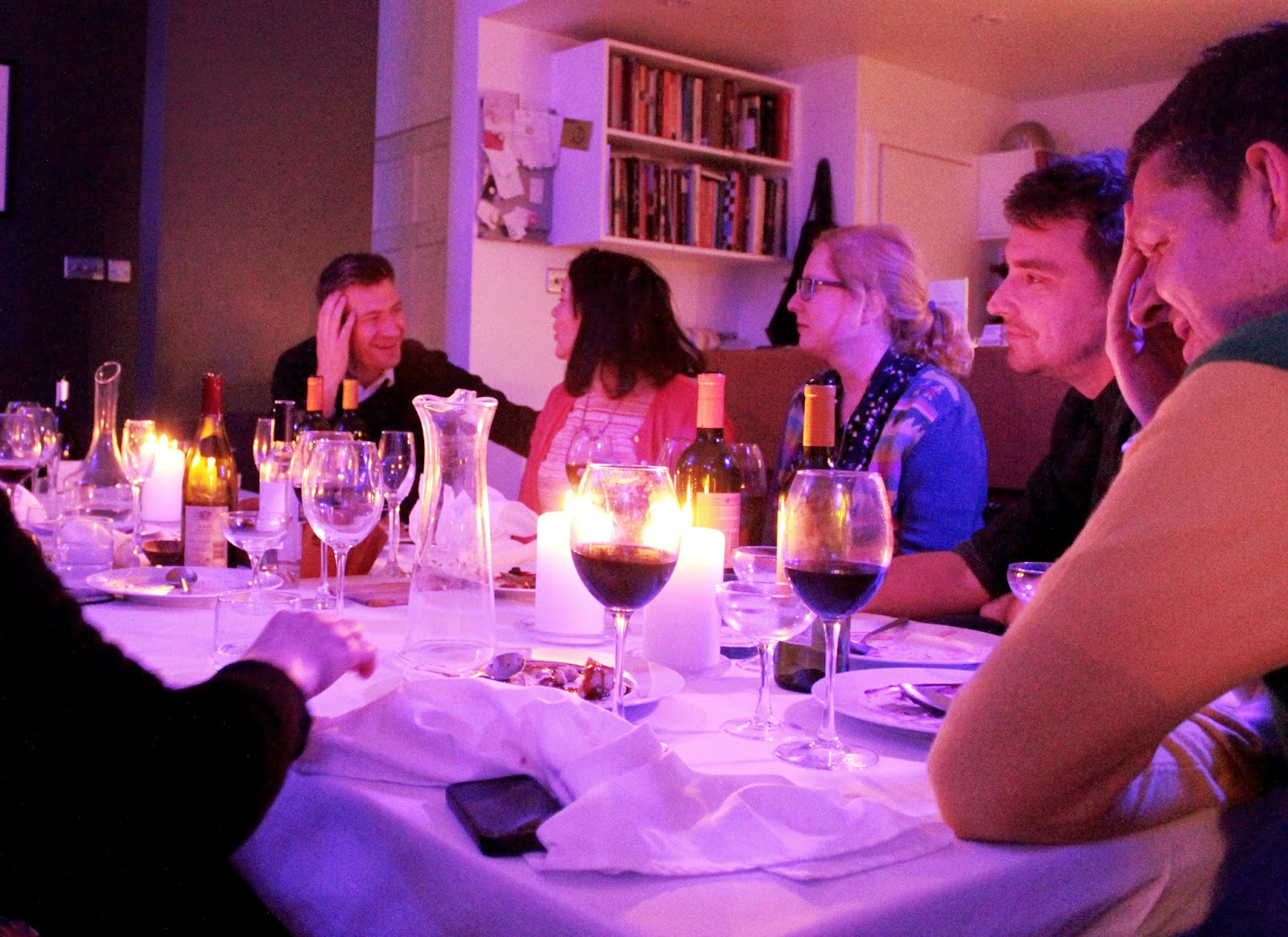
What's the collective noun for beauticians? A pride? A pluck? Maybe a chortle? Tessa Stevens is one such and well known in Enfield for her salons/parlours - I'm not sure of the terminology. She booked in with a posse of friends and colleagues, all in the business, and their spouses, who weren't. They arrived with a sense of determination... to enjoy themselves. The evening would be flogged for fun. It dare not resist.


Tessa's posse. She's third from the right.

Marc Spelman, Tessa's partner and a seriously impressive magician arrived later after a gig. He wowed my son/waiter Etien on a 2013 visit. That's Marc on the right.

We were planning on doing a before and after group shot. But no one remembered the 'after'. Shame, as I fancied making something of the fabulous 'appearing' magician. 
It was Zoe's birthday so Tessa had brought a prearranged and home made cake: chocolate and peanut butter; Zoe's favourite. I had agreed a dessert I hoped would complement the cake.

I was trying to develop my much admired butterscotch mousse from Daisy and Sally's visit. I needed a recipe that didn't necessitate a whipper and that didn't reduce down to a sticky puddle in ten minutes. I plumbed a Nigella idea, not normally my choice but she is famous for being sweet and sticky.

Too sweet, a midweek trial proved; muscovado overkill. (Though no talk of a sugar rush please, it doesn't exist. Yet another food myth). I modified the Nigella, adding more cream and meringue (yeah, NOW it's healthy) and served it with chantilly cream for a flavour contrast. For texture, I made a salted peanut brittle and blitzed this to a jagged crumb. I stuck in a long langue de chat too, for no good reason other than to stop the dessert looking too splodgy.


To make Butterscotch Mousse (serves 8 or 20 depending on how sweet their teeth are).

This is a combination of butterscotch, whipped cream and simple French meringue.

Melt 75g unsalted butter with 100g muscovado sugar and boil for three minutes. Add 200ml of double cream and bring to the boil again. This is the butterscotch. Set aside to cool (as in: you should be able to poke a finger in without a third degree burn).

Whip 200ml double cream to soft peaks (don't let it get too stiff) and fold into the cooled butterscotch.

Whisk three egg whites to soft peaks then gradually add two tablespoons of caster sugar and continue to whisk until the meringue is firm and glossy. Fold this into the butterscotch/cream. Fold it until there is no streaking of mixture but be gentle; don't flump out the air you've just spent ten minutes whisking in or your mousse will sit like a damp rag in your stomach.

The mousse should be refrigerated until needed but don't keep it longer than a few hours. I make mine about 30 minutes before serving so it's chilled but still light.

I'd like to develop this into a full dessert rather than just an accompaniment. The issue is the sweetness. A few spoonfuls are delicious but a bowlful is sickly.  I'm going to try making an espresso Genoise sponge soaked with a coffee syrup; a near bitter element to foil the sugar. Pictures and progress will be reported.

Incidentally, no one knows what the Scotch part of the name means; certainly nothing to do with kilts, lochs or distilleries. It might have been scotching as scoring, cutting the confection up like toffee or it could be scotch as scorch, the heat needed to caramelise the sugar.

Oh, and Angelo, I'd love some of the olive oil if you can spare. Sounds awesome. Thanks.

Monday, 14 April 2014

Spring lamb and legumes crushed

Rack of lamb chops with a herb crust

Rack of lamb is a prized joint, both tasty and tender if treated with some respect. It is usually presented French trimmed, meaning the tougher muscle is removed from between the ribs which are then left protruding. Any decent butcher will do this for you. I use F. Norman in Oakwood, North London. I've noted the supermarket packs also tend to remove the top fat and so, much of the flavour. Racks can be sewn together and formed into a crown. But that's too fancy for my table. I serve the meat with a simple dish of crushed broad beans and peas that have been blanched and then heated with olive oil, mint and marjoram. The flavours as well as the colours complementing well.

Rack of spring lamb with a herb crust

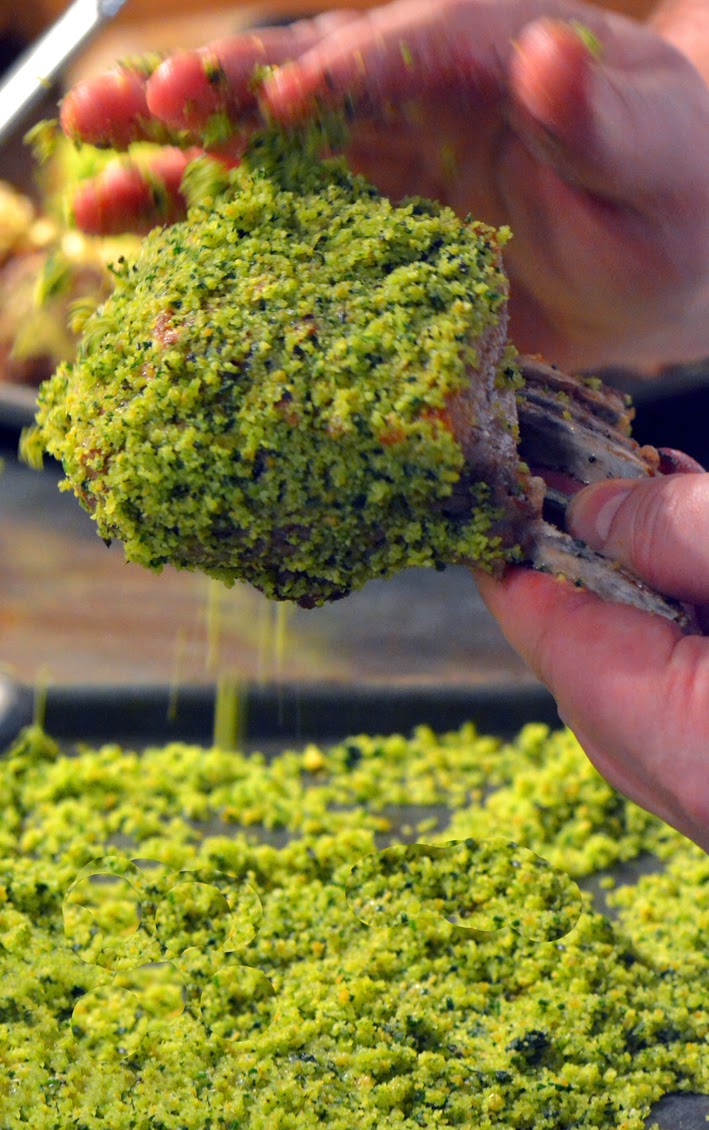
Crusting the meat. Vibrant and tasty.
This dish is based on a Gordon Ramsey recipe but there are many others just like it. You need three ribs per person. Racks are normally eight or nine ribs. This recipe has the advantage that the lamb is cooked once then rested before being crusted and cooked again just before serving.

Make your herby crust mix by mixing two handfuls of breadcrumbs with about a half handful of grated parmesan. Blend this with a good sprig of parsley, coriander, thyme and rosemary. Add a drizzle of olive oil until the mix comes together. It should be an attractive and vivid green. Add more parsley if it's not.

After scoring the top fat and seasoning well with salt and pepper, sear all sides of the rack in a smoking hot pan. You want a good brown colour. Now roast the meat for around 12-15 minutes (depending on the size of the rack) at 220°C.  I was using organic Gloucestershire lamb and these were fairly hefty. Supermarket cuts seem to be more delicate.
Out of the oven and while still warm, brush liberally with Dijon mustard. The mustard will melt into the meat. Then press the meat into a tray of the crust mix, coating all sides. The meat should be rested for at least 20 minutes... or until needed.

For a pink medium eat, the lamb should be returned to the 200°C oven for another 10-12 minutes, but again, if the joint is small, make an inspection cut before time. When ready, cover with foil and let rest for ten minutes. Then joint the lamb into chops and plate up.


Gravy

The one downside of a rack: it yields little roasting juice. Instead, I make a stock of the roasted meat trimmings with a chopped roasted shallot and some rosemary in two litres of water. No trimmings? Try a half kilo of scrag end - a couple of quid at most - roasted for thirty minutes at 220°C. Reduce this right down to almost a syrup, adding a good glass of port and a tablespoon of redcurrant jelly towards the end.


Crushed and herbed peas and broad beans (to serve 8)

No it's really not like mushy peas. I'm actually a big fan of the guacamole of the North and this ain't it. 
Broad beans, peas and a red spatula

Take 400g each of frozen petit pois and baby broad beans (Waitrose sells these). The baby versions are sweeter than their elder siblings. Frozen? I know, I know, but unless you are literally podding yourself and walking the produce to the kitchen table then frozen is best. So called 'fresh' peas in the supermarket are like lead shot even after a day or two.

Blanch both peas and beans separately for a couple of minutes in plenty of boiling water, until they float. Plunge into ice water (the legumes not you) and set aside until needed. Before serving,  in a blender or (better) food processor, whizz up the pea/bean mix with a tablespoon each of fresh mint and marjoram. Make an effort to find the marjoram, it's an intriguing flavour, like a more erudite and interesting oregano. Don't puree the veg, you want texture. Add 180ml of good olive oil and gently heat. Why gentle? Because a fierce heat will turn those luscious greens to an unappetising dun. Finish off with a seasoning of salt and white pepper and the juice of half a lemon.


To serve, put a mound (must be a better word than mound? Heap? Pile? Nope.) of peas in the centre of the plate, surrounded by three chops and a drizzle of lamb and port reduction. I'd serve them with a deep dish of potatoes dauphinoise but you could go lighter. Perhaps some Yorkshires? They aren't just for beef.


Some of the photos here were taken by my friend Bee Rawlinson. You can see more of her excellent work here. She can find beauty in the most mundane of subjects (apart from me - she did try). You'll also see much more of her work on this blog in the coming months. If you need a food photographer, let me know and I'll put you in touch.


So Marc said: You sounded intelligent when you talked about food, now you sound like a child.

It's because I was talking about football. I know nothing about football. The trouble is, most men can't quite accept that I mean this; that I know NOTHING. They think I'm being self deprecating; that I have, as most men do, a working knowledge of the game and the current positioning of the Premiership. I don't. Men look at me, blinking with something like annoyance, like I've let the side down. Honestly nothing. I even told my Frank Lampard story: that I met him at a BBC party once and asked him what he did. To be honest, I wouldn't recognise him if I met him again now. Sorry Frank. I'd be able to point out Dave Beckham or that Man U player who the Mock the Week panellists claim sleeps with old ladies and looks like a potato... but almost no one else. So Marc was probably justified in his assertion.

Marc's party had roast onion and goats cheese tart for starters. Mains of rack of spring lamb with crushed peas and broad beans. I backfilled the deal with big creamy portions of potato dauphinoise.


They decided to go for, what henceforth will be known as, the 'Cheers' shot. Marc's on the far right (of the picture, I hasten to add, no idea of his politics).


Pictured below is the lamb and crushed peas & broad beans along the vegetarian option of Yorkshire boats (or coffins) filled with roast veg in a sweet and sour(ish) sauce.


And the onion and goats cheese tart starter. It's not much of a looker, I know.


And the potatoes dauphinoise... afterwards.


Rooney! That was the fellow.


Daisy & Sally, salty mousse and cats' tongues


"I'm going to be be late." Said Daisy. She was calling from a field in Cambridgeshire. I understood, she was excited. She was, after all, on the set of her new drama series. I can say no more than that. 

Daisy and Sally are both TV writer friends of mine and have been 'planning' this visit for months now. As this was a semi-social event I added another small course; a pre-dessert. Daisy had her heart set on a sticky toffee pudding but I'd thought it too heavy now we're in spring (kinda, sorta). I compensated by devising a salted caramel mousse. This is a technical thing, only made possible with the use of a whipper - a piece of pro kitchen kit. You mix salted caramel sauce with liquid egg white and compressed nitrogen gas and squirt. That's the theory. In practice, it's all about density and temperature. Too warm and the mousse will blurt and dribble; too cold and it will sulk in the can, never to be seen. However  on the night all things came together. It is one of the most delicious things I've made but it doesn't keep well - a half life of about three minutes. This shortlivedness necessitated a bit of table theatre: shot glasses being filled and handed round with haste. I also made some crisp langue de chat biscuit spoons to eat the mousse with. The trick here was not to eat the spoon before you finish the mousse.

A temptation not everyone could resist. Much fingering followed!

Biscuit spoons. Langue de chat is 'cat's tongue in French.
They look nothing like a cat's tongue though so no idea why the name. 
I was doing my rack of lamb with crushed peas and broad beans for the first time, combined with a vegetarian alternative of Yorkshire pudding boats filled with roast veg. Both need very accurate timings. I especially didn't want to serve grey meat. Rack of lamb is a pricey cut and is best served still pink. But also, no one wants either a doughy Yorkie or burnt batter.

Course, in the rush, I frickin' forgot the group shot. Table shots is all I have.

Daisy is here, in the middle.


And Sally, also in the middle.


Sunday, 6 April 2014

Caroline and the 'reverse Keeler'

Caroline was booked in as a party of ten but after two rather serious phone calls was reduced to a six. This meant they were faced with rather a large joint of pork belly to contend with. There were no complaints. They didn't quite finish it all off.


Not to scale
 My youngest son Etien, on waiter duty that night, was rather thrown to find one of Caroline's guests was Tracey, his primary school teacher. Always a certain tension when serving 'Miss'.

I'd warned them about the group shot and at first, despite my urgings, wanted to go for the standard 'school shot'. I thought we should at least do this properly, with some chairs for the front three. By this time the men had decided they wanted to look mean and moody. And anyway, Tracey changed the look of the thing with her 'reverse Keeler'.

Caroline's front right. Do the men look mean and moody? Not sure they do.
As I suspect will be the case, the set-up shots reveal rather more than the official picture. I love this one. The men still don't look mean though.


And finally, I'm happy to report that there was also a little dancing. Very unusually, the men initiated it with This Charming Man. But here's Caroline and Tracey dancing to Queen.


Wet mushrooms and John Torode

Firstly, apologies. This is shameless 'sleb piggy backing. Mr Torode only makes the most fleeting of appearances here, and then only by twitter. Secondly, this isn't nearly as funny as I hoped it'd be. Maybe I'm not on form today but this is quite a dry read (and that's pretty much the only gag herein).

John Torode did initiate this post because he scolded a Masterchef contestant for immersing mushrooms, claiming they soak up water 'like a sponge' and wash away flavour. I've always thought this was a piece of kitchen myth so tweeted John Torode and the Masterchef program:

@MasterChefUK @JohnTorode1 if mushrooms absorb water "like a sponge", why don't they swell up and burst when it rains?

He replied:


@NewRiverDining @MasterChefUK .. Because the top ok the underside absorbs the water, which doesn't get wet when it rains .

OK, so even allowing for some strangeness in his language, this still isn't a very satisfactory response. Rain bounces for a start and mushrooms sit in vegetation which gets wet with precipitation and dew. If mushrooms act like sponges wouldn't the moisture be wicked off anything that comes in contact with them? John didn't reply to my further replies with links to debunking websites but someone called @HelenWestern did suddenly launch herself at me "you're clearly no fungi to be with". I can only assume she's his internet minder.

Purists talk of using a stiff, dry brush or wiping with a damp cloth but I prefer to wash mushrooms as I've noticed sizeable pieces of soil (I hope it's soil) can get trapped inside the mushroom gills. Wiping will not remove these. Yes, it's easy to wipe buttons, chestnuts, ceps and portabello but what of delicate oyster, trompette de la mort or pied bleu? There's no way you can wipe the deeply pleached and perforated surface of a morel.


Sod that!

Mushrooms are 90% water anyway so will a little external dampness really make much of a difference to their flavour? Cooking them is about removing water.

McGee debunked this some time ago. As have several others. But I decided to do my own investigation. I do, so you don't have to. No mushrooms were hurt in this process. That's a lie. They all died and were eaten but at least they didn't die in vain. They perished in a perfectly delicious ham hock, rocket and vermouth sauce.


Massacre!

I weighed a supermarket pack of chestnut mushrooms. 324g. I had accounted for the weight of the plastic box.


I washed them. I would normally put them in a colander and give them a blast under a cold tap but this is the nuclear option.


Then I shook off the excess water and weighed them again in their original packing. They were still damp to the touch.


335g. They have taken on 11g of water, that's just over two teaspoonfuls. 11g represents an increase of mass of 3%. This is more than I would have expected but I seriously doubt this is enough to wash away the flavour of the mushrooms. There were about 20 mushrooms in the pack so that's about half a gram of water each. And certainly, much of that was surface water and so would evaporate on contact with a hot pan. A 3% take-up cannot be equated to a sponge. 

I think it's therefore safe to wash mushrooms. See, no jokes.

Monday, 31 March 2014

Redcurrant Jelly (or: SEE! It doesn't always work for me)

Nice colours... but not much else
I've been asking around for a quality redcurrant jelly. I use it a lot, often in beef and lamb gravy. It adds an interesting fruity sweetness. I've never found one with much depth of flavour though. It's all been a bit one dimensional. Anyway, answers there came but one: make your own. 

So I did.

Not good.

I imagine the arse end of an awful winter is not the right time to be buying berries. I did anyway. £4 for two tiny Sainsbury's punnets. Yes sir, we saw you coming from the end of the road, maybe further. Probably raised under glass in the dim, watery, wintery sun. About as effective as being bullied into growth by an asthmatic with a torch.

I boiled the berries gently in just enough water to cover, for about ten minutes, until tender. Then dripped them over a muslin-ed sieve for a few hours. I then added 130g of sugar to the collected liquid and heated it all to 104°C.

The result... It's not much is it? 

Frankly, you disgust me.

Think how much liquid there would be without 130g of sugar. Nice colour? Yes. Expensive? Very. Packed with flavour? No. Interesting? No. Different to shop bought? Only in its lack of flavour.  I think I'll try again in the late summer, maybe pick my own berries.
NEXT!


Even easier focaccia


Look at that texture! I make this bread at least once a week. I've been experimenting and found that if you only prove the dough once you get a lighter texture and no less flavour. This means the want-focaccia-eat-focaccia cycle is now under two hours. I realise there may be purists squeaking with alarm and indignation but I cannot tell the difference between one prove and two. In fact, guests actively seem to prefer this new recipe. I know my children do.

You'll need a small square baking tin. I use this 9" square one. Don't use anything bigger or you won't get as good a rise (too much surface area). Take 100g of plain flour, 200g of strong bread flour and 10g dried yeast. This is more than one of those little packets but you shouldn't be buying them anyway. Buy a little tin. They're next door on the supermarket shelf. If your scales doesn't do 10g then just use a tablespoonful. Mix this up. If you're Popeye, go ahead and do this by hand in a big bowl. Otherwise use a mixer. Don't use the dough hook, use the normal paddle. Add 50ml of good olive oil mixed in with 220ml of cold water. Yes, cold. Beat this in and let the machine run for a few minutes. Now add 5-10g of salt and three inches of rosemary, finely chopped. Let the machine run until the dough starts to look shiny and elastic. It will be sticky. You would struggle to knead this by hand.


From this, lumpy mix...


To this. Smooth, elastic and with a shine. See those long, glutinous strands?
That will give your bread structure.

Splash a little oil in your tin and then Pour/scoop/scrape the dough in also. Press the dough into the corners, working the oil into the dough. You don't need to cover this. The oil will prevent the dough drying out. Let the dough prove in a warm, draft free space for at least an hour, until it's at the top of the tin. 

Bake at 230°C for just 13-15 minutes. You want a good golden colour. While it's still warm, splash the top with good olive oil and a sprinkle of sea salt.

When it's cool, I cut mine into squares and griddle (as above). This adds much flavour. Serve with olive oil and balsamic vinegar or a chunky tomato sauce (or a tin of soup).


Saturday, 29 March 2014

The group shot - let's make a change


Introducing the new group shot. I'm bored of taking the same photo at the table. It needs a big depth of field for a start and invariably I don't have enough light - unless I turn everything on and have my guests blinking and grimacing into the camera like bug eyed chameleons under the Attenborough torch. No. Let's start the evening with a shot composed by the group. Ideally with some narrative. Maybe with props.

This is the official pic of Sam's group (Sam is front left). I did rather spring the idea on them. They discussed suspending someone at the front but settled for the school photo. Sam is another Palmers Green adventurer in food and has just started up a company called Layla's Pantry (@LaylasPantry) making premium quality comestibles. She's starting with peanut butter but the plan is to have an ever expanding range.

Back to the group shot... I actually think I prefer this picture. It has the disadvantage that you can't see many faces but it does have mystery. What is Graham looking at?


Monday, 24 March 2014

A recipe book. Or not.

Just insert words and pictures

I get asked if I am going to 'do' a recipe book. Well, no. Not really. Why? Because no bugger is offering me any money to do so. Because I am an unknown in a vast field. Because, save for this meagre effort, I am awful at self promotion. But mainly because all my recipes are pinched from other people (just as they pinched before them). Alright, some are original assemblies of elements from other recipes (but also pinched). It's almost impossible to be truly original in cooking. Food is old. Eating is old and really rather popular. If it can be eaten it has been. If it can be pureed, freeze dried, sun dried, sous-vided, desiccated or flock sprayed, it has been. And that's just ONE of Heston's recipes for chips.

However! I have let the notion distract me. If I were to 'do' a book, what would it be? How could I compete for shelf space? What would my spine appeal be? In what manner would dear readers covet my covers?

Well, I finally have my approach.

I am very systematic in my approach to things. If I'm good at one thing, this is it. I like to make molecules; to break parts down to their simplest constituents and then rebuild. It's why I'm good at organising. You cannot cook well if you organise badly. OK, you can make a sandwich without fear of injury but a six course meal might mean you losing a limb.

I also notice that while recipes are obviously necessary they are problematic because they stop you thinking about the various processes involved. Why do you blanch the onion first? Why seal the meat? Worse are the calls to not overwork or overwhip or underbake without testimony or illustration to reveal when you are close to infraction. What are the parameters? I once saw an instruction to use water that was NEARLY boiling. FFS.

Also, and all too often, some recipes merely repeat instruction for reasons unknown., like wipe not wash your mushrooms. (Heston is very good at debunking cooking myths.) Mushrooms don't absorb water you know. Try weighing them before and after a deluge if you don't believe me. The web has been brilliant too at allowing the truly dedicated, fixated and pedantic to flash their wares. The Syrup and Tang site has so many pictures of macarons/macaroons at every stage of the process. BUT  of the mistakes and the successes. They do so you don't have to. I found it invaluable.

Great numbers of people, reticent and querulous as so many are when put before an oven, do just follow the written injunctions. They/you know no better.  It's all very well for Nigel Slater to tell you that recipes are only blueprints and encourage rule breaking but you have to understand them before you can break them and if this the first, and probably last, Mary Berry layered chocolate rum cake you've ever made and it's for Nanny Jones' 80th and Sainsbury's have no more of this good chocolate left... then you sure, as eggs are something Delia taught you to boil, aren't going to branch out on your own. Are you? Does it matter if the cake tin is 12" and not 8"? Where in the oven should it be? Does a fan really change the cooking time? Does opening the door matter? Nanny Jones says it does - but she's off her face on the rum. Your mother did warn you. She may be old but she's sly.

I want a book that's like a Latin Primer. Simple examples that illuminate future complexity. Let's say a dozen recipes that introduce you to all the basic techniques and the chemistry of cooking. Each step would be photographed. Overwhipping and underbaking would be demonstrated. You need to know the verbs and nouns before you approach the sentence  This would definitely include a loaf of bread. There are only four ingredients necessary in bread: flour, water, yeast and salt. So how come so many awful loaves? (For that matter, how come so many appalling martinis - where there's only three,if you include the twist and you really should be*). You need to know about gluten and how this is a matrix to capture the gas the yeast makes. Bread is a gluten foam that is hardened by heat; by baking in an oven. The book would explain all about gluten; when it's good to work it and when it's not. You want it in bread but not in pastry. I think I'd like a simple central recipe with annotations all around. You can read the instructions but also learn the reasons for the instructions. Maybe pages you could fold out? It's as complex as you want. A culinary Talmud if you will. After the simple recipe there would be further, more complex breads with other ingredients. I think this may work well as a tablet app.

There would also be a simple sponge cake recipe. The most basic cake used to be called a pound cake by the Victorians because it used a pound each of fat, flour and sugar. That's all cake is. But it's also what biscuits are... and pastry. What's the difference? What's 'short' mean in a crust? Probably need to know about gluten again. I want the reader to understand exactly why they are adding eggs, or baking powder or ground almonds. If you know WHY it's there, you will be able to remedy situations when you've forgotten to add it. Or if you can leave it out.

We need a little physics too... sorry... but if only to deal with cake tins. How often does the tin in your kitchen match the requirements of the book? I have a deep 8" square not a 10" round but the mix fits. Should I change the cooking time? And why specify 20-25 minutes if you're not to to explain what might happen in the interim? What's meant to be going down - apart from the middle when you take it out too early?

I'd also have a roast chicken (for cooking muscle and making stock), a meat pie (for pastry and slow cooking), some pan fried fish, a white sauce, and custard.

So that's my idea. I don't even have a name for it yet. Anyone fancy financing it? Anyone going to Amazon me a link to just such a book?

*******************

Postscript. My friend Bee (wonderful photographer - she makes the mundane beautiful) suggests this could be a simpler, more practical version of McGee. She's right.


*And the number of times I've seen bartenders lovingly strip off a piece of fresh zest and then twist it AWAY from the glass. Sheesh. It's about the citrus oils! That's the difference between a mediocre Martini and staggering home at 4am with a strange mobile number written on your hand.