Thursday, 9 June 2016

British lasagne and a bit about authenticity


Three stories, some foodie burble and then a recipe. Cut to the end by all means if you're hungry. It is long; I've nothing else to do.

One.

The winter of 1989 and my first time in Ireland, working as a sound technician in Belfast's Grand Opera House as part of the RSC's Les Liaisons Dangereuses world tour. I was excited, not least because I'd recently acquired a taste for Guinness and had been assured by THE WHOLE of the drinking world that Guinness was better in Ireland.

At the first professionally appropriate moment - you can't be drunk and operate a show - I sat in the glorious and famous Crown Liquor Saloon just opposite the theatre, with a pint of the black stuff brimming beneath my fricative lips. About to sup; a little sigh; this might be a memorable moment.

It tasted exactly the same as in my London local.

Later... I was informed by loquacious, lubricious and well lubricated locals (sorry) that a pint of Guinness can only be properly enjoyed within ten miles of the river Liffey.

Fast forward ten years and I'm at the wedding of a Dublin friend. Between ceremony and reception I hotfoot from hotel to city centre pub. This was the real deal. Wooden everything, dusty floor, old men whistling their badinage through crooked teeth. Christie Moore tipped a bodhran in the corner (or possibly not). My heart in my mouth, I ordered my pint of Ireland's best loved and most famous.

It tasted exactly the same as my London local.

I may have been too vocal in my surprise as I was promptly but politely informed that this was a 'new' pub. If I wanted a proper pint I should visit an 'old' Dublin pub. A few names were thrown at me. But... I had a wedding to attend. No time.

A few years later and I'm in Dublin with a whole evening free. I'm working on a medical drama for RTE. My Irish producer wants to take me for a pint. Where did I fancy? How about an 'old' pub? He knew just the place...

It tasted exactly the same as my London local.

In fact, the best pint of Guinness I've ever had was in Hong Kong. In a modern pub too. 

Now I think about it, the best spaghetti carbonara I've eaten was in Madrid. 

Two.

My first real food obsession was Thai. (I'm discounting all the childhood confectionery cravings.) After trying it in Hong Kong - the Asia leg of the same RSC tour - I was determined to replicate it in a London that, in 1990, was very much Thai free. I had so much to learn. There were chillies for a start. So many chillies with apparently so many flavours. And Nam Pla (fish sauce), galangal, shrimp paste, fresh turmeric, lime leaves, coriander roots.


Pea aubergines
Research was tricky as there were precious few cookbooks and only a nascent internet. I rang restaurants, bored store owners in China Town, consulted horticultural epics in Palmers Green library and rang Sub-continental supermarkets in Wembley. I put in the hours and the miles. I knew the subtleties between the regions of Lanna, Isan and Bangkok cooking.

After a few weeks I'd assembled what I considered to be the most authentic collection of Thai ingredients available to a North London amateur cook. I prepared my dishes. I invited friends over.

They tasted good (the food, not the friends) but nothing like I remembered. And then one of my too-travelled friends (already a source of irritation as they arrived late claiming to be still operating on 'Indian time'. Can't bear tardiness generally but especially with food) pointed out that my apparent Thai experience was Chinese anyway.

Three.

I researched a series about art fraud once. I had a wonderful, well wined evening in Sally Clarke's restaurant with my producer Foz; the ex-head of the Scotland Yard fine art department and Axa's senior loss adjustor for artwork. The experts confirmed what I'd suspected: much of the art in even the best galleries and museums is fake. Estimates vary but none put the figure below 20%.

Camille Corot, a 19th century, French landscape painter is one of the most copied. It was noted in Time magazine that Corot was prodigious, producing some 800 paintings in his lifetime.

But there are 4000 Corots in the USA alone.

So at least 80% of the paintings that give so much pleasure are the result of decades of endeavour by men and women of considerable talent... to copy, exactly, someone else's work and not give their free expression free reign. 


You have to wonder. If those centuries of combined effort had been spent on origination... how much richer might our culture be?

Burble.

What does authenticity even mean in food? What is 'original' or 'true'? You'll often hear the reprimand 'this isn't real Italian/Greek/Chinese/Indian, of course' from some pontificating type as they poke at their chicken tikka masala or taramasalata.

The words real, traditional and especially authentic are bandied as if meaningful; often said with a snobby disdain; reproachful of local efforts. I disagree. All food, if made with... (I'm gonna say it) love, with care and skill, is 'real'. It might not be like the fish dish you had next to the harbour in Thessaloniki on your brother-in-law's wedding or from the street vendor in Ko Samui but... that dish would be different in the next shop, street or town. And your memory is faulty. Things are often better in your head than in your mouth. Taste is a combination of sensations and emotions.

Cooking should be about making the best of what you have not traipsing far and wide in the pursuit of some notion of perfection. And what is 'the best'? It has to be a consensus, but taste is entirely subjective. You only have one mouth. Perfection, like truth, is expressed severally.

You could almost see it as the difference between a forgery and a new expression. Don't imitate, innovate. It doesn't matter if you can't get the exact same blend of herbs and spices so long as what you make is differently delicious.

The challenge comes when there is no real equivalent ingredient. I spent three hours travelling to a wholesalers in Shepherds Bush to get pea aubergines for my Tom Ka Gai soup. There is nothing similar in the West. But if I'd omitted them and instead worked on the recipe would my friends have noticed? If they'd noticed, would they have cared? The lesson maybe is don't spend so much time and expense when something local is, yes, different, but really just as good. Most of the world's long loved and lasting dishes were peasant food, made with what was available. Do that.

Don't claim the dish as authentic, it won't be anyway, even with the correct ingredients. Just say: it's inspired by... Call it your Chicken Tikka Palmers Green.

These much meanderings are all in the service of justifying my own family recipe for lasagne.

Lasagne is a dish that no one thinks needs defining. It's a layered dish of pasta, meat sauce and cheese sauce yeah? But... which meat? Which sauce? Which cheese? And what about vegetarian lasagnes? What about chicken lasagne (don't!) or seafood 'lasagne'? Oh yes, put it in quote marks why don't you? You can get vegan, gluten free lasagnes now; a pasta, cheese and meat dish without pasta, meat and cheese. Even the Italians can't agree on anything much. They're even deconstructing lasagne so it's no longer a layered dish. You'll easily find recipes talking about a béchamel sauce which then specifies egg yolks and ricotta. 

But I don't care what the Italians do. I'd be happy to call this a braised pork and beef, pasta layer bake with a white sauce topping... but who's got the time? The Italians can't agree on the most basic measure of authenticity. There's much more of a sense of pride in hyper-local cuisine but, concomitantly, much more argument.

There was a national scandal recently when the mayor of Amatrice rounded on a celebrated Italian chef who dared include a 'touch of garlic' in his Amatriciana. Oh, the horror. Amatriciana is a recipe apparently millennia old and shouldn't be adulterated. The fact that two of the six ingredients, tomatoes and chillies (along with chocolate, potatoes, peanuts, avocados and vanilla) were only introduced to Italy about five hundred years ago, was deemed unimportant. You have to love the Italians for their outrage though. I wish the British were more passionate about their own produce.

Recipe.

Lasagne ~or~ the Palmers Green meaty, cheesy, layered pasta bake
Serves eight hungry people or two teenage boys.

Why lasagne?

We had big drinking friends coming for dinner so I needed a menu where the skill levels needed to be proportional to my sobriety. A fussy starter was fine, but then a simple main course and a dessert I could assemble if blind and unable to walk.

And I hadn't made a lasagne for ages. 

Lasagne is not a simple dish. There is a lot of prep. People always seem more impressed by a roast lamb chump and some dauphinoise or a beef wellington, but there's much more work in a lasagne; evinced by the length of this recipe. Perhaps we've mistaken ubiquity for ease. Bung in the foil pack... or pierce the plastic. PING! An Italian treat. Not.

Supermarket offerings are all, uniformly awful: heavy, sticky, flavour free, leaden slabs of mince and carb. They are NOT made with love. They are made with a margin in mind. A decent lasagne is quite an undertaking so we might as well make it a good one.

I'm breaking my lasagne into three elements and sub dividing one. 


  • Pasta.
  • White sauce.
  • Ragu - comprising of vegetable base, red wine reduction, braised meat.


Pasta. Yeah I made my own. I know, I know. You won't. But here goes. I wouldn't attempt this without a pasta roller. You can borrow mine. I hardly use it.

To 600g of '00' flour add six eggs. mix to a pliable dough. Add more flour if your dough is too wet or a splash of water if too dry.

 Knead by hand until shiny and elastic. This never takes less than ten minutes. Put the radio on and pummel. This is a Northern Italian pasta. In the south they would simply use semolina and water.

Roll the dough through the machine but stop one short of the thinnest setting. Lasagne needs to be fairly robust. Cut roughly to the length of your lasagne dish for ease of use. Lay flat between layers of floured, greaseproof paper if not using immediately. I hung mine on the back of chairs to dry out overnight. They warped so I had to soften them in a tray of hot water before use.

OK, so allow me a little defence before we move onto white sauces. Home made is thinner and better tasting. It's fresh for a start. I make mine with six pasta layers not three which seems to be the supermarket standard. This results in a PASTA dish and not just a plate of mince.


Warped egg lasagne

White sauce. Is it a cheese sauce or is it a white sauce? Is it a Béchamel? Mine is a plain white sauce with three fresh bay leaves... and then a load of cheese added. Do you know what bay leaves taste like? I think for years I had no idea. I'd chuck some grey, desiccated leaf in, because a recipe told me to, and not notice the difference. For good reason. There was no difference. You might as well add the cardboard box. Try to get some fresh bay leaves. I have a little bay tree in a pot on the patio. They're hardy and difficult to kill. You're welcome to take some.

I use a mix of cheese. Always parmesan with either a strong cheddar or gruyere, or all three. Many recipes specify ricotta or even mozzarella. I don't see the point, these delicious but subtle flavours will melt away into the background. We need something to stand up to the meat.

Make a roux with 50g of butter and 50g plain flour. Melt the butter and stir in the flour to make a paste. Now add in a pint of full fat milk, in increments, stirring the mix smooth as you go. It's quite hard to get lumps as long as you take it gradually. When all the milk is in, simmer the sauce for a few minutes to cook off the any remaining floury taste. Next, a big lump of mascarpone, at least a tablespoon. How much I leave to you and your waistline. Add three fresh bay leaves and leave to steep for a while. You've plenty else to be getting on with. Don't season it yet as there's cheese to come and some cheeses are salty. A good dose of white pepper if you like.

Add cheese to taste. At least 50g of parmesan. 100g of cheddar or gruyere. Taste it. Maybe more? I have friends who use a mild blue cheese but that's a sensation too far for me. Finally, season with salt. if it's too thick (your preference) relax it with a little milk. Set aside. You might consider covering with cling film to stop a skin forming.

Ragu or meat sauce.

To make a good, thick, soft, rich ragu, you need a large, lidded pot, or you need to get creative with some tin foil. We tend to confuse ragu, which is just a meat sauce, with bolognese. Understandable because that's the only ragu most of us will eat. This lasagne ragu is closer to one claimed by Naples; containing much more onion and red wine. Although, a Neapolitan sauce should be made using whole chunks of meat. Traditionally, a Bolognese ragu contained little or no tomato at all and was much more about fried mince with a dusting of nutmeg. Take a look here for more about regional ragu variations.

Firstly, which meat? I favour the (apparently) traditional blend of 50/50 pork and beef. Obviously if pork offends use all beef. I get my lovely butchers, F. Norman in Oakwood, North London, to grind me a mix of stewing steak and pork shoulder. For eight people you want about a kilo in total.

Brown the meat. And I don't mean 'cook' the meat on the hob. Think of this as searing a steak. Remember to season the meat first. A good crunch of salt and black pepper. Mince is often made from the parts of the animal that would normally require slow cooking. If you cook it quickly it will firm up, even when it's minced. Instead get your best, thickest pan smoking hot and sear the meat. Colour equals flavour. Get a really dark crust on it. It's fine if much of it is still raw. We'll be braising anyway. For the moment, remove the browned meat and set aside.

Of course, ragu is handy stuff to have in the freezer. for a cheeky midweek spag bol. I'd always make double this quantity and freeze half.

Vegetable base. Nothing unusual here. In the same dish that you browned the meat, sweat off two diced onions over a medium heat, diced small in some butter, for 15 minutes or so, until soft and golden. I add a few star anise (a Heston trick) as it seems to produce a more savoury flavour. Grate three medium carrots and three sticks of celery. But before you add them in, increase the temperature of the pan so the onion browns a little. Now cover the pan and sweat the mix for ten minutes or so. Finally, remove the star anise, if used. Add two teaspoons of dried oregano and a half tablespoon of chopped fresh thyme and fresh rosemary.

And no, I didn't forget the garlic. I don't use any in my lasagne.


I think lasagne is a meat dish so I don't want too much tomato. Maybe most of a large jar of chopped tomatoes. I prefer a chunky blend to a sieved passata but it's not a deal breaker. You could use two tins of chopped tomatoes. I don't add tomato puree. I also don't add chopped pancetta. I think that smoke has no home here.  The (almost) always brilliant Kenji Lopez-Alt of SeriousEats fame, suggests adding blended livers. Don't just wince you non-offalers. This might be a good, cheap way of adding a real meaty depth. I'll report back.


I add a beefy base by reducing a litre of beef stock (if it's not home made, don't use it) with a bottle of red wine. Reduce by half then add to the veg base. The red wine brings body and colour but also a much needed acidity to the sauce.

Now pile in the browned, crusted meat and put the lid on the pot. This needs slow cooking. Best to do it the night before. I have a duration function on my oven - three hours at 130°C. A half hour either way will make little difference. I put it in and go to bed (or to play hours of, ahem, Command & Conquer). 


Slow braised ragu. Remember to season. Handy for other dishes too.

So you have your home made pasta (or something in a packet), the slow braised ragu and the white sauce. Firstly taste your ragu; it will need seasoning. Some salt no doubt, plenty of black pepper and perhaps a pinch of sugar. if there are lumps of mince, they should break up with some gentle pressure.


Place a layer of pasta in the bottom of your dish. Spread with a layer of ragu. Repeat. Then a layer of pasta and some cheese sauce. Two more layers of pasta and ragu and a final topping of pasta and cheese sauce. A good sprinkle of cheese on top. Cheddar and gruyere will melt and string whereas parmesan will crisp and crunch. Some people add butter and breadcrumbs with the cheese.

Bake into the oven at 200°C for about half an hour until everything bubbles. Serve with a sprinkle of basil leaves or even better those tiny Greek basil leaves.

I served mine with blanched beans, pan-fried in a little butter with chopped fresh thyme and some toasted almonds and a simple salad of rocket and lambs lettuce dressed with oil, lemon juice and a decent balsamic.

Is it the best lasagne? I doubt it. Is it good? You tell me. Is it authentic? You bet.


Tuesday, 17 May 2016

(Not) ginger snap biscuits


The British apparently like nothing more than a nice cup of tea and a biscuit; certainly more than all that genital based unpleasantness in the bedroom. I know I need one right now (a biscuit!), having just zested and juiced eighteen lemons. 

You see, I wanted ginger biscuits to go with my new lemon posset dessert. I considered the ginger snap/nut - one of the UK's most popular crunch - but I've always found them the baked equivalent of a manhole cover, sometimes needing massive molar mastication to break the things. No, for the quivering, light, lemon posset, I wanted something delicate and flavoursome but with the bite and bake of Britain's favourite biscuit.*

Biscuit is an prime example of semantic shift. Stick with it - you know I love a little etymological tangent. Biscuit means twice baked in French. This would be more like an Italian biscotti now: a lump of dough is flat baked and then sliced and rebaked to a heart stabbing hardness. In the UK, a biscuit is a flat, crisp unleavened thing. In the USA it's a tall, soft cake, more like our savoury scone; often served with gravy. What they call gravy can be a white creamy sauce too, studded with bacon and sausage. It's a good thing an ocean divides us.

I made these thin and delicate but there's no need for that really. Leave the mix thick by all mean, just remember to increase the baking times. You can let them crisp up or eat them soft and chewy like cookies.


Ginger Biscuits
Makes at least 30 (round ones as above)

Beat together 175g caster sugar, 1 egg, 2 egg whites, a teaspoon of ground ginger, four tablespoons of the syrup from a jar of stem ginger and 100g of soft butter. Then add 350g of self raising flour and mix well. 

Take three knobs of the stem ginger and cut up very finely. Stir into the mix. These create tiny pockets of deep gingerness to be tongue discovered.

Taste. If you want a more gingery taste, add more ground ginger. You should have a sticky paste. Roll about a third of the mix between two sheets of baking paper (or silicon sheets if you have them) until it's only a few millimetres thick, then transfer to a flat baking sheet. Remove the top layer of paper. Some mix will adhere but this doesn't matter; just scrape it off and reuse. You can make them much thicker if you want but this will obviously need a longer bake at 180°C. Timings depend on thickness.


Bake at 200°C for 7 minutes. The top should be golden brown. Cut the still soft biscuit into your shapes of choice using cutters or just a knife. Carefully turn the pieces over and return to the oven for three more minutes to dry and brown the bottoms.


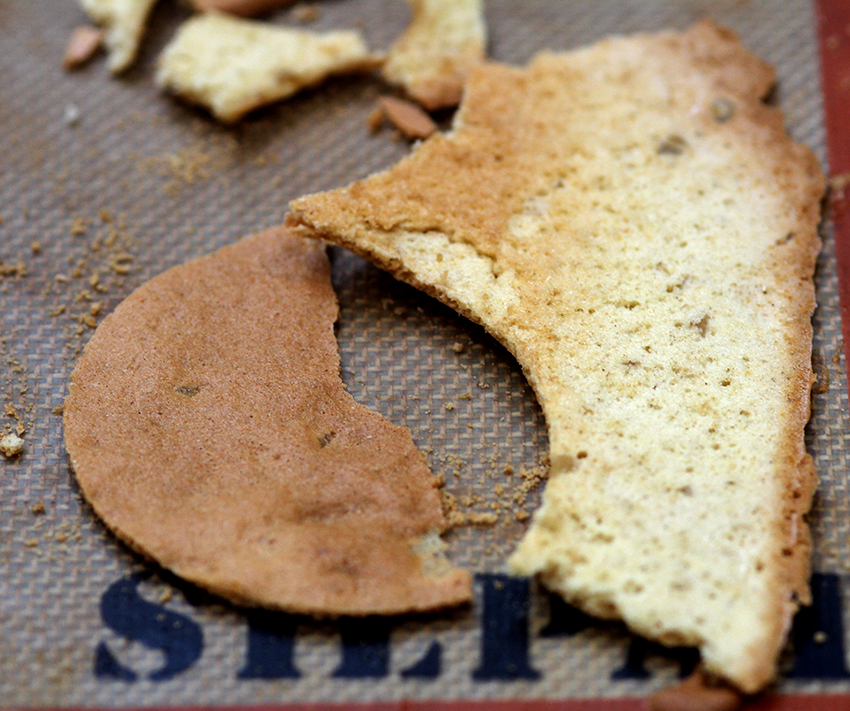
This is an underbaked bottom (right). The left is what it should look like.
These are versatile biscuits but they will go soft after a couple of days. Not a problem if they're just to go with coffee but you can, anyway, 'refresh' them with a three minute bake in a 180°C oven. Once cool they will be crisp again. That's the official difference between cake and biscuit, by the way. Did you know this? Cakes go hard when stale; biscuits go soft. Hence Jaffa Cakes.


*An outright mendacity. Sorry. The ginger snap/nut is in fact only the country's eighth favourite biscuit it was revealed in some nonsense poll probably commissioned by the people who make Hob-Nobs.


Served here with lemon posset


Monday, 16 May 2016

Lemon posset

Lemon posset and ginger biscuits


The trouble with having attended to the infancy of both my boys is that I can't help but think of posset as that pre-sick stuff you find down the back of your jacket, usually just before you're meant to leave for JUST ONE EVENING without the kids. Of course, invariably this would be my best dark Boss suit jacket.

So to be clear, that's not what I'm making here. That kind of posset is easy to make anyway: take one baby; feed; agitate; hoist onto shoulder for kitchen-dancing.


In retrospect, starting a recipe for my new delicious, creamy dessert with pre-sick stories wasn't the best idea. It's a good thing I don't do this for some corporate shilling.


You go though many lemons making lemon posset. This weekend it was 26. Although that included two goes and some lemon bars. I once juiced 140 limes for a cocktail party that brought on some kind of anaphylactic comedy face swelling the next day. I have to demand ask my family to do limes now.


None of this is making you feel like making lemon posset is it? That would be a shame. It's a wonderful dessert, creamy but citrus with great mouth-feel. If you like panna-cotta but you've never made posset, you should. It's easier and more flavoursome.


That's better: a positive vibe.


As you might know, I do like a British dish. Posset is such and goes way back. In fact Lady Macbeth poisoned the guards with dodgy posset just before the regicide and that disobedient dog. Mind, Bill was a bit rubbish at historical research so I wouldn't take it too seriously. Nevertheless, there are many recipes dating back to the middle ages. This kind of thing:

"When it is prettily cooled, pour it into your pot, wherein is about two spoonfuls of Sack and four of Ale, with sufficient Sugar dissolved in them. So let it stand a while near the fire, till you eat it."
The Closet of the Eminently Learned Sir Kenelm Digby, Knight, Opened - 1669.

Posset was until quite recently, more of a custard thing. You can find pictures of 'posset pots' with spouts. The modern take (and the one I prefer) is a firmer set. 


Talking of recipes, as is my wont, I read many and tried a few before deciding on my own. Posset is a simple enough dish, taking only four ingredients: cream, sugar, lemon zest and juice. The only issue reported was one of graininess. Posset is all about the texture. Most recipes will mention 'silky' at some point. But if you heat the cream and sugar slowly at first and then be sure to simmer for a few minutes, I can't see why you won't get a smooth set. For reasons of texture too I strain the mixture. There's no place here for boiled zest.


Which one?
Beware recipes that specify a number of lemons rather than an amount of juice. This is plain daft. Ignoring the fact that lemons come in different sizes, the amount of juice extracted will vary with your the time of year, their ripeness, your method and forearm strength. Do remember to roll the lemons under your palm before squeezing. This does make it easier. I use an add on juicer device for my KitchenAid. It's the only one I've ever encountered that works with limes as well as doing a brilliant job with lemons and oranges. Like all KitchenAid accessories though it is fairly pricey.

Setting. Yes. There's no eggs or gelatine of course. It's the action of the citric acid on the milk proteins that converts this from a drink to a pudding. Just like if you put acid into milk it will curdle, if the milk is warm it will curdle more so. Cream is different due to its much higher fat content; the sugar too will mollify the reaction.

Some recipes were ferociously citric. Too much for me. Posset should be lemony of course but also a creamy balm. However you do need to use the zest too for that lemon flavour. Remember that's where the taste is, in the skin. I decided on roughly one lemon between two people.

Zesting is made much easier with a fine, Microplane grater. These aren't expensive and can be found everywhere now. They cut through the skin, rather than mash it. they're great for parmesan too.


Before you serve a posset give consideration to the portion size. This is a very rich dish - essentially double cream and sugar. My first attempt in 175ml ramekins, defeated even the heartiest family appetite. You need something larger than a shot glass but much smaller than a ramekin or a dessert bowl. I found these 120 ml amuse bouche glasses and am very pleased with them. You could use liqueur glasses or small tumblers. Wine glasses are also OK, but you'll need long handled spoons then of course, or very fine fingertip control.


Lemon Posset
Serves 8

Gently heat 800ml of double cream with 260g caster sugar and the finely grated zest of four medium lemons. Heat gently, stirring frequently to ensure the sugar dissolves fully and the cream doesn't catch. Bring to the boil, then turn down the heat and simmer for a couple of minutes. Lots of recipes insist on a three minute boil but I see no reason why.


Strain the mix through a sieve into a jug and then pour back into the pan. Whisk in 140ml of lemon juice (about four medium lemons but you may need more). Heat gently again and you should see the mixture thicken.


Pour into your chosen serving receptacles and allow to cool to room temperature. Then refrigerate for at least six hours until gently set.


Traditionally served with some kind of biscuit, often shortbread. I made a light, gingery thing (based on the ginger nut) and topped the posset with some blueberries that I'd barely heated with an allspice sugar syrup. In the supper club I served this with a lemon bar (an American standard), topped with Italian meringue, so yes, lemon meringue pie in all but name. Recipes coming soon.


Light was too low so this is a bit blurry. Nice combination of creamy and tart, smooth and crunchy.


Monday, 9 May 2016

Roast shallot bread (to make beetroot and goats cheese toasts)


This is a variation of my focaccia, a bread I've now made hundreds of times. So often in fact that I barely weigh anything and I can tell when the dough is ready by the sound my KitchenAid mixer makes. The bread is only proved once, which should send purists into hysterics but calm yourselves, it's a slow prove at least and no one's ever complained of a lack of flavour. This would make the most delicious cheese on toast. Which is kinda how I use it here. Also great to make croutons for a soup.

Here I purposefully make a thin wide bread that I can slice into long, thin strips to be first griddled and then oven dried. It's a light, moist bread with a deep savoury flavour but also hints of sweetness from the caramelised shallot.

I developed this as a base to my starter of beetroot and goats cheese toasts. Yes, you could call it bruschetta but I live in Palmers Green, not Italy.


Two types of goats cheese with beetroot puree and crisps and a little roasted walnut atop my shallot bread.
The leaf is red veined sorrel from my garden.

Roast shallot bread
Makes one half kilo loaf

I make this with a mixer as it's a wet dough but you could do it by hand. I'd still use a bowl to knead it though.

Add 150g each of plain flour and bread flour in a bowl. Add to this 10g of dried yeast, a big pinch of sugar, a tablespoon of sea salt, about 250ml of cold water and 50ml of oil and mix well.

For this bread I used an English rape seed as I thought the nuttiness of the oil would work well with the onion flavour. I'm using less and less olive oil now in favour of local rapeseed. This is Hillfarm, available from Waitrose (I think). If you don't taste your oils, you should. They affect the flavour of any recipe but especially a focaccia style bread like this.

The mix should be very soft and gooey. Beat with your machine, or by hand, until the dough is very smooth and elastic and starts to clump on the beaters. You should be able to pull a long filament of dough away without it snapping.

While that's doing... finely chop three long shallots and fry off gently in 40g of unsalted butter. You want to soften and cook until it's golden. You could use eight small, round shallots but it's much more work. No shallots? Use half an onion.


This is a huge one. Yours will be much smaller.
Once the shallot mix is golden, whack the heat up and stir frequently. You want to char and caramelise some of the edges to get that wonderful deep savoury smell as well as a little sweetness. Once done, allow to cool. Don't go bunging hot onions into the dough will you? It might kill the yeast.

When the dough is ready, stir in the cooled shallots and butter, kneading a few times to distribute.

Slosh a little oil around the bottom of your tin and stretch out the dough. You can also use a baking tray, as I did for this.

Leave for at least 90 minutes, in a warmish, draught free place (like cupboard) until tripled in size with nice big air bubbles visible on top. I'm looking for a slow rise here to allow the flavour to develop. It might take two hours. That's why I used cold water rather the traditional luke warm, if you were wondering. 


By the way, the term prove here is an old meaning: to test. In bread baking, it was to test the yeast. It's the same meaning we use in the expression 'the exception proves the rule'. The rule is tested by the exception. It doesn't mean the exception is proof of the rule. How could it be? Sorry, but this winds me up.

Back to the bread. It should have risen by now.

Once risen, treat the dough VERY gently. Any knock will have it deflating faster than an X-factor competitor's ego. 

Bake at 230°C for about 15 minutes.


Someone took a chunk out before I could take the photo. This was made in my cast iron skillet. I can't remember why.


Thursday, 5 May 2016

Apple charlotte puddings

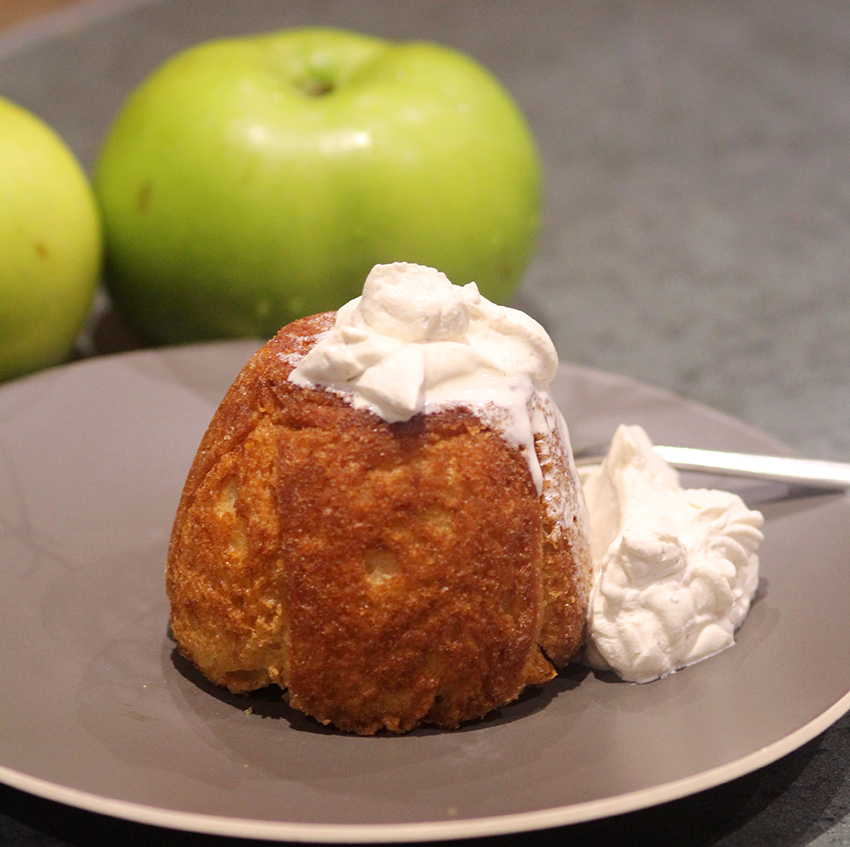
It was warm, so the cream slid off. You wouldn't want it looking perfect would you.
This won't make it into FoodGawker that's for sure.


I sit here, happily disconcerted by the May sun. The back doors pushed fully open, listening to the morose thrum of the too close North Circular and maybe a distant lawn mower - the first this year. The warm, busy, London silence normally reserved for Wimbledon. Any moment now there'll be a grunt and a thwack and some polite applause. Fifteen - love. Wasn't it winter only a week ago? That can be the only reason why I served a big, sticky pudding to Katie and her party.

Early spring can be tricky for desserts. There's no fruit to speak of other than perennial lemons, oranges and apples. I've wanted to make apple charlottes for a while. It's basically bread and butter pudding turned in on itself. Crisp and golden, buttery bread cases filled with a plump glut of sweet/sour fruit. This is classic British stodge, like suet puddings, jam roly-poly and spotted dick. Just had to check that spelling. Why isn't it rolly-polly? Tsk. English orthography eh?


Once at a restaurant in Southwold with Belinda, when the boys were young, Etien was scanning the menu when he shrieked with laughter and pointed, beaming with happy astonishment. Spotted Dick. He simply wouldn't accept that this was a bona fide English pudding. He insisted that it was some mistake or joke, even when assured by the waitress. He giggled for hours. He still does.

First lets look at the initial letter. Should that be a capital 'C'? That depends on which history you believe. Was it named after Queen Charlotte, wife of George II, patron of apple growers (apparently) or was it a French or even Russian creation, or maybe a corruption of an earlier Jewish dish named Schaleth, Schalet or Schalat? It is one of those dishes often found prefixed as 'quintessentially British', as so often things are that are rarely eaten here.

I tried out a few recipes before serving to guests, as is my custom. I learned a few things:

  • Apples when cooked, even Bramleys need a perk of acidity to keep us interested. So I added lemon juice and zest.
  • Good, artisan bread, such as Holtwhites, my baker of choice is not regular enough in its consistency. I had to eschew the good stuff and go with Waitrose medium cut white. I know, the horror.
  • A lot of recipes use ceramic moulds such as ramekins to bake the puddings but I fancy a metal container gives a crisper result.
  • A combination of both well stewed and slightly poached apples gives a pleasing mix of chunks and goo.
  • Keep them small. The one above is a 175ml pudding. Any larger and even your family will struggle when you add the inevitable creams and custard.

Apple charlotte puddings
Serves 8

Peel three large Bramley apples, decore and cut into bite size chunks. Place in a heavy bottomed pan with four and a half tablespoons of sugar and 25g of butter. Add the juice of a lemon and all the zest, pared into strips that can be removed at the end. Add a handful (to taste) of golden sultanas and a pinch of clove powder.

Cook, covered, on a very low heat until the pieces are softened - about 15 minutes. Stir occasionally to stop sticking but not so often that you mulch the apples.

Remove half and continue to cook until the remainder is pulpy. Perhaps another ten minutes. Combine chunks and pulp. Taste for sweetness. You may need more sugar, apples vary greatly in tartness. You can now add a glug of apple liqueur or calvados.

Butter well eight moulds. these should be around 175ml size. About the size of a muffin.

Using plain, sliced white bread, cut a template to fit your moulds. This will be a small round, a strip, or strips to line the sides and a larger round to cap the lot. Having little cake/cookie/scone cutters helps a lot here.

Butter all the pieces well and dredge well with caster sugar.

Line the moulds with the bread.


Preheat the oven to 200°C. Brim the moulds with the apple pulp and place on the bread caps. Bake for at least 30 minutes. These are not especially time sensitive. Once the bread is golden and crispy, the puds will slide out of the moulds easily. Honestly. If the first isn't gold enough, slide it back in and go another five minutes.

They will sit happily, upturned in their tins for 15 mins.

If it's winter, custard will work well. If Spring, maybe an ice-cream. I made a vanilla and served it with an apple crisp and some fennel seed granola.


Katie wasn't too impressed with my puds. I sought her opinion and she gave it. A little heavy, she thought. Her friends were of a range of opinions. I agree with her though. This is probably one best enjoyed in the depth of dark midwinter.

Katie and friends, now recovered from a heavy charlotte.


Wednesday, 20 April 2016

Pickled celery, dried celery


The simplest and quickest of any pickle I've made. This was done mainly as a garnish for my roasted celeriac soup but I fancy you'll be seeing it in plenty of other places. With pork for sure, but I suspect with fish too.

Celery is one of those easy to overlook vegetables. Often salted with onions and carrots for so many savoury bases but not often given pride of the table.

This recipe is based on Nathan Outlaw's. Don't skimp on the fennel seeds.


Pickled Celery

Remove the fibrous base and finely dice one head of celery, cutting thick stems into two or three first then cutting in cubes. Or just chop finely. I wanted the square look. In a pan add 100ml of white wine,  100ml of vinegar, 100ml of water, 100g of sugar,  30g of fennel seeds and a big pinch of salt and bring to the boil. Simmer for a couple of minutes then allow to cool.

The wine is hardly cooked so you will taste it. I prefer a semillon or sauvignon blanc but just use whatever you have open, so long as it's half decent.


Dried Celery

Now, as I'd bought a lot of celery for experimentation, I wondered what powered celery would be like. The quick answer is 'almost non existant'. Celery, as any fule kno, is very, very, very largely water so the oven drying took a full 24 hours at 70°C. I should have gone lower as that may have preserved more of the vivid green colour but I couldn't entangle my oven for two days. Once dried I broke it up and put it in a grinder. Oh boy.


This, some time later, turns to this:


So unless you really, really want to taste powered celery, I'm not sure it's worth the cost and bother. I'm bet you're glad I warned you.


Roasted celeriac soup


I'm not sure how to write this. It's generally about soup but also features the best meal I've ever eaten; the inspiration behind this recipe.

Let's start with the meal. It was at Midsummer House, Daniel Clifford's Michelin two star in Cambridge; a place I've been wanting to try for ages. There was no real occasion. We were visiting a friend in Halesworth and decided to do a tour of Cambridge with Etien (and his new girlfriend!) on the way home.


I'll put the menu up so you can see what we had but I don't want to review the meal... apart from to say it was catastrophically brilliant. I've not had better... or paid more. Wow. It was expensive. My wallet was left severely traumatised. It was worth it though. It was the ten course tasting menu. Ten courses with an additional five canapé courses and chocolates at the end. We'd actually ordered the seven course menu but after a couple of canapés I switched. One of the canapés was a celery sorbet in a Bloody Mary foam. It was one of the best things ever to enter my face. Later there was a dish of celeriac, hazelnuts and celery. I was inspired to make my own celery family dish. 
I say 'inspired' but in truth, the meal left me a little downcast the next day. It's a little like scaling a mountain for many hours, pausing to take on water, feeling near the top, only for the clouds to clear and realising you've not much left base camp. I will never cook this well. This was astonishingly accomplished food. I can hear my wife and children kindly offering caveats (they are professionals; there are 32 staff for 40 guests; they use ingredients that I can't afford; they have all manner of gadgetry) but there is a certain plangent humility in realising - and tasting- that there is a height you will never attain, no matter how hard you try. This isn't me looking for plaudits, honestly. 

If you value your food, try and go there... once in your life. I'm hoping to revisit. Maybe for my 50th birthday which is advancing fast.

And so to soup.

Ugly bugly

Celeriac, essentially the root of the celery plant, must be one of the ugliest veg. It looks like a warty turnip with a ghastly mass of tentacle roots. Its appearance may be off-putting but please persevere, it's not hard to work. Cut off the roots and peel the skin and you have a waxy white mass, not dissimilar to a potato, full of flavour and minerals. Scrub the skin with a brush of some form, to ensure you remove all traces of grit and dirt.

Initially I'd thought of a brilliant white soup, with just the roasted insides of the celeriac. Served maybe with a blob of sweet, black grape must as a contrasting garnish. But once I'd cooked the root slowly (two hours and more at 160°C) and tasted various parts I realised that  most of the flavour was in the skin. Much like my roasted cauliflower dish, the natural sugars had caramelised, bringing a sweetness and complexity to the table. Given I have a oooper-sooper-doooper blender now I figured I'd bung the lot in and see how it turned out.

It turned out great.

Roasted for two and a half hours

Does this look like a beaver to you?

Roasted Celeriac Soup
Makes about a litre.

Take one celeriac and trim the roots right back, trimming off anything too fibrous. Scrub the veg well with hot water. We're going to eat the whole thing.

Roast on a baking tray for at least two hours at 160°C, until the insides yield to a tentative hand. It will wheeze when you squeeze, like an asthmatic tortoise*. This will vary, depending on the size of your roots. Don't go faster and hotter as you may burn the skin. Dark, sticky brown is fine but black and ashy is more suited for the crematorium than a soup. 

Allow to cool and cut into small chunks. Blend this with milk and some cream until very smooth. You may have to sieve the liquid, depending on the effectiveness of your blender.  This is the only real work in the recipe. Blending a whole celeriac is a bit of a potch. How much milk and cream is up to you. Start with 500ml and add more if you need to physically blend. I wanted a fairly thick, velvety texture so I added some double cream too but you need not.

Season with salt, white pepper and the juice of at least half a lemon. The soup is actually quite bland until you add salt. Don't be afraid to add quite a lot, just do it carefully, tasting as you go. 

Now we come to the garnishes. Cream is obvious but I wanted some crunch too so I toasted some sliced almonds. A little contrasting texture and acidity was needed so I pickled some celery and added a few crenelated gems (sorry . But would cream and pickle go? I wasn't sure at first until I realised that with a small tilt of the head, the question becomes 'do cheese and pickle' go? Then the answer's obvious.


*No, I've never torturted a tortoise, asthmatic or otherwise. I'm just really bored and the metaphor amused me.